First page Google: Dominate SEO 2026!
Why Landing on the First Page of Google Changes Everything
Ever heard the joke about where to hide a dead body? On the second page of Google. It is dark humor, but it reveals a harsh truth: if you’re not on page one, you’re invisible.
First page Google rankings are not just vanity metrics, they are about survival. Independent industry studies consistently show that the majority of clicks go to page-one results. For example, multiple analyses of click-through data indicate that the top organic result often captures more than a quarter of all clicks for a query, while the second page receives only a small fraction of overall traffic. Research from sources like Backlinko and HubSpot helps illustrate how dramatic this drop-off can be.
Some key takeaways that align with these findings:
- The large majority of web traffic goes to websites on Google’s first page.
- The #1 organic position can capture more than a quarter of total clicks, while page two gets only a tiny percentage.
- Organic listings receive far more clicks than paid ads, because users typically trust organic results more.
For local business owners in places like Albuquerque, Rio Rancho, or Santa Fe, this gap directly impacts whether customers find you or your competitors.
Today’s search results page is more than just links; it is a dynamic space with AI Overviews, Featured Snippets, and Local Map Packs competing for attention. Understanding how Google organizes information is key to breaking through.
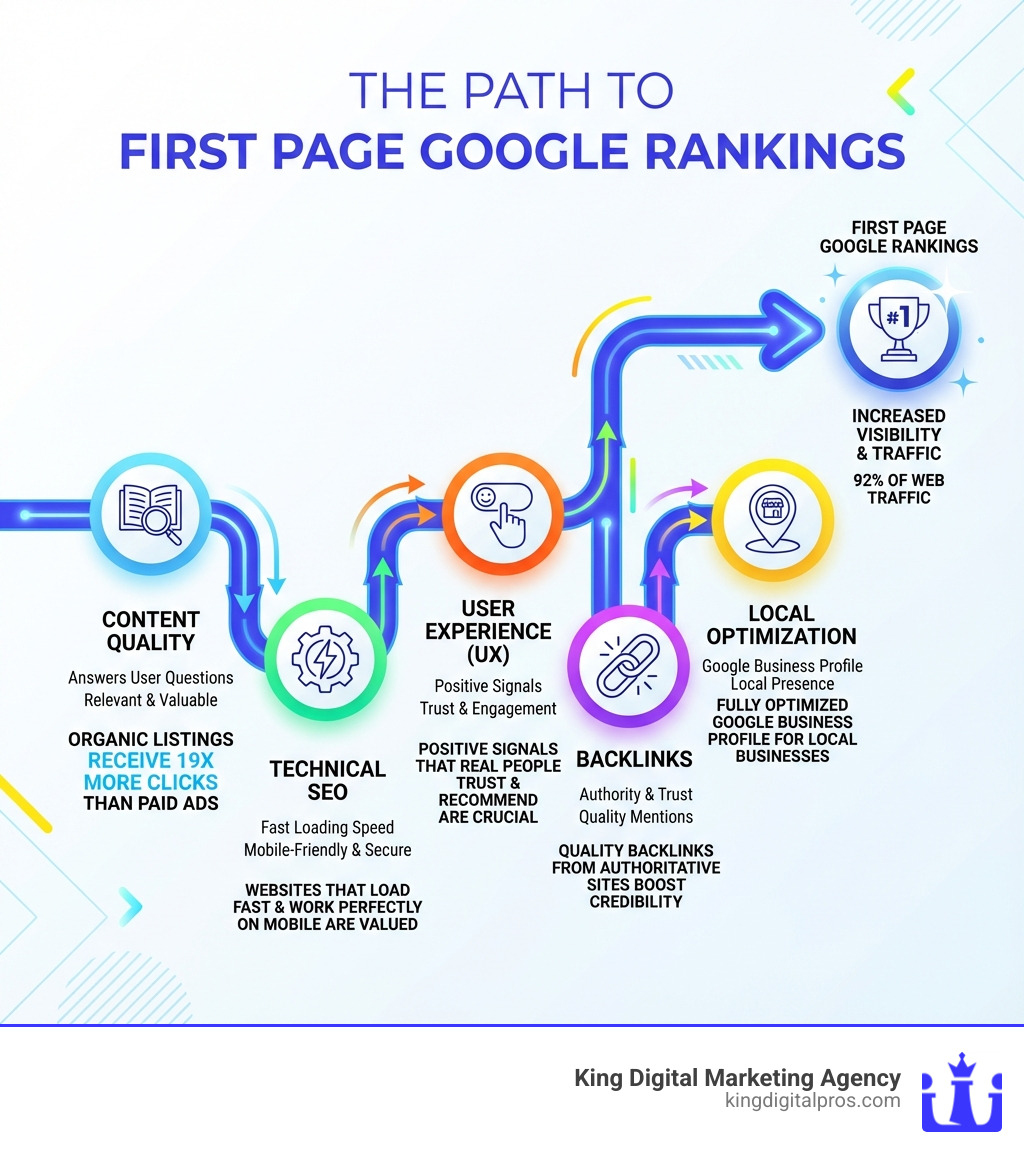
The stakes are high: page one rankings mean more credibility, traffic, and leads. Success requires understanding what Google values: helpful content, a fast mobile-friendly site, and genuine trust signals.
I’m Bernadette King, founder of King Digital Marketing Agency. I have spent years helping local businesses achieve First page Google rankings. This guide will show you how to make Google love your content and put it where customers can find it.
Know your First page Google terms:
Why Page One is a Game-Changer & How Google Decides Who Gets There
Ranking on the First page Google is the digital equivalent of having a storefront on the busiest street in Albuquerque or Rio Rancho. When customers search for your services, being on page one means they find you first, leading to more visibility, credibility, and leads.
So, how does Google decide who gets the top spots? Its algorithm’s core mission is to provide the most relevant, high-quality answers to a user’s query. It evaluates pages based on many different factors, often summarized into key pillars that are also reflected in Google’s own documentation and independent resources such as the Google Search Central documentation and the Search Quality Rater Guidelines.
Google looks at:
- Meaning: Understanding the search query’s intent.
- Relevance: How well your content matches that intent.
- Quality: The trustworthiness and helpfulness of your content.
- Usability: How easy your website is to use.
- Context: Factors like location, search history, and settings.
A critical concept for quality is E-E-A-T: Experience, Expertise, Authoritativeness, and Trustworthiness. Google wants to see content created by a trusted expert with real-world experience. This is especially vital for “Your Money or Your Life” (YMYL) topics like health or finance, where accuracy is paramount.
The Evolving SERP: More Than Just Ten Blue Links
Gone are the days of ten blue links. Today’s search engine results page (SERP) is a dynamic landscape. Understanding these elements is key to maximizing your visibility.
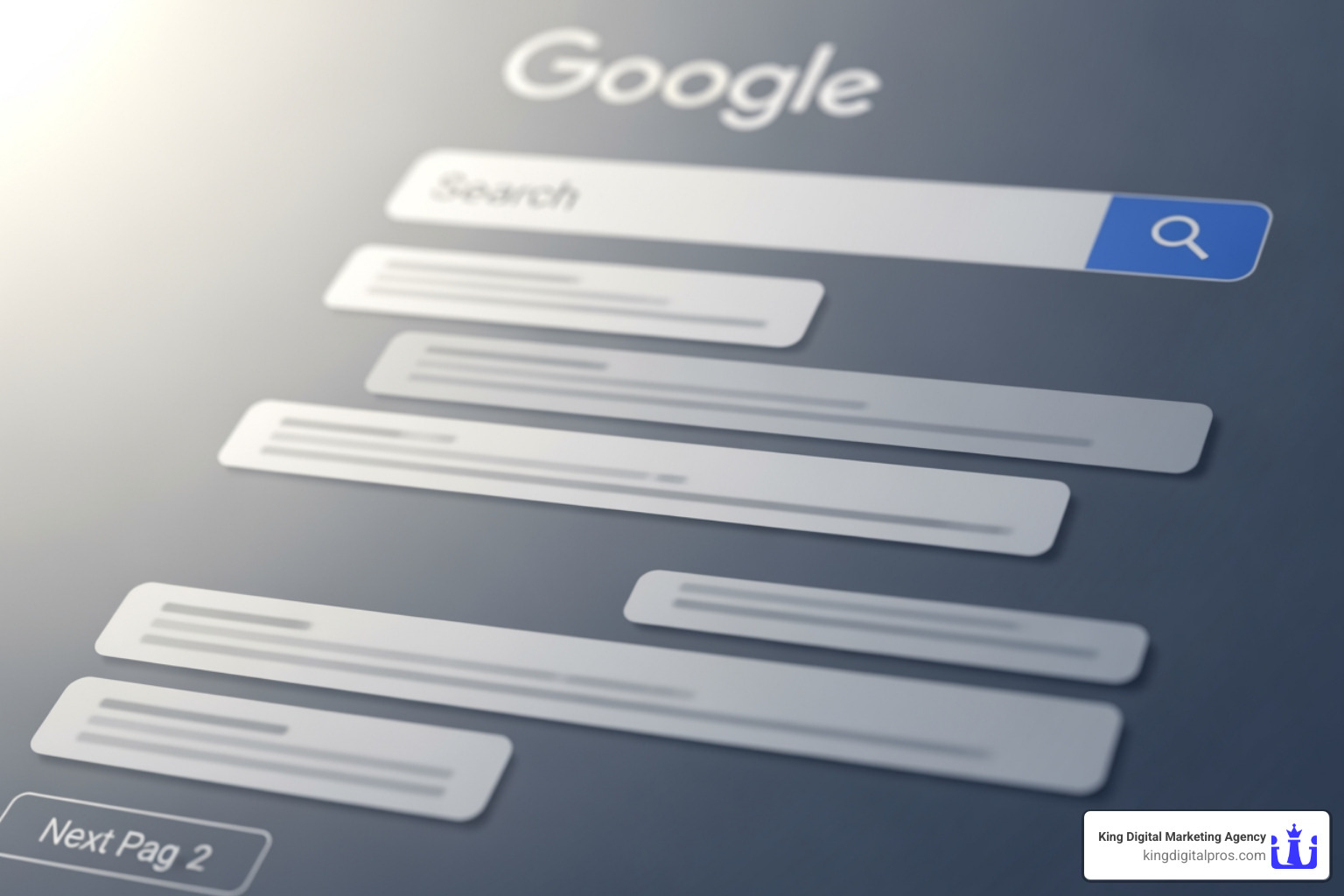
Here is what you will often find on Google’s first page:
- Organic Results: The traditional links ranked by relevance and authority, which still capture most clicks.
- Paid Ads: Paid placements at the top and bottom of the page for immediate visibility.
- Featured Snippets: “Position Zero” boxes that provide a direct answer to a query, pulled from a webpage.
- AI Overviews: Introduced in May 2024, these AI-generated summaries offer quick answers, and being sourced in one can boost visibility.
- People Also Ask (PAA): An expanding list of related questions that can feature your content.
- Knowledge Panels: Information boxes about entities (like your business), often fed by your Google Business Profile.
- Local Pack: Crucial for businesses in Taos or Grants, this map-based feature lists nearby local businesses.
- Image & Video Carousels: Visual results, often from YouTube, for certain queries.
Your strategy must be multifaceted, optimizing for every feature that can put your business in front of customers.
Understanding User Intent: The Core of Google’s Algorithm
At its heart, Google’s algorithm tries to understand user intent – the why behind a search. Aligning your content with user intent is a direct path to a First page Google ranking.
There are four main types of user intent:
- Informational: Looking for information (for example, “how to fix a leaky faucet”).
- Navigational: Trying to find a specific website (for example, “King Digital Marketing Agency”).
- Commercial Investigation: Researching before a purchase (for example, “best SEO services Albuquerque”).
- Transactional: Ready to buy or convert (for example, “buy organic coffee Santa Fe”).
Google uses signals like your location and search history to personalize results. For our clients, understanding local user intent is paramount. A search for “plumber near me” in Rio Rancho has clear commercial intent, and your content must speak directly to that need. Our Local Keyword Research Complete Guide can help you pinpoint what your customers are searching for.
Core Strategies for Improving Your Website’s Google Ranking
Achieving a First page Google ranking is a marathon, but it is a race we have helped many local businesses win. Our approach combines several core strategies that signal to Google that your website is the best answer.
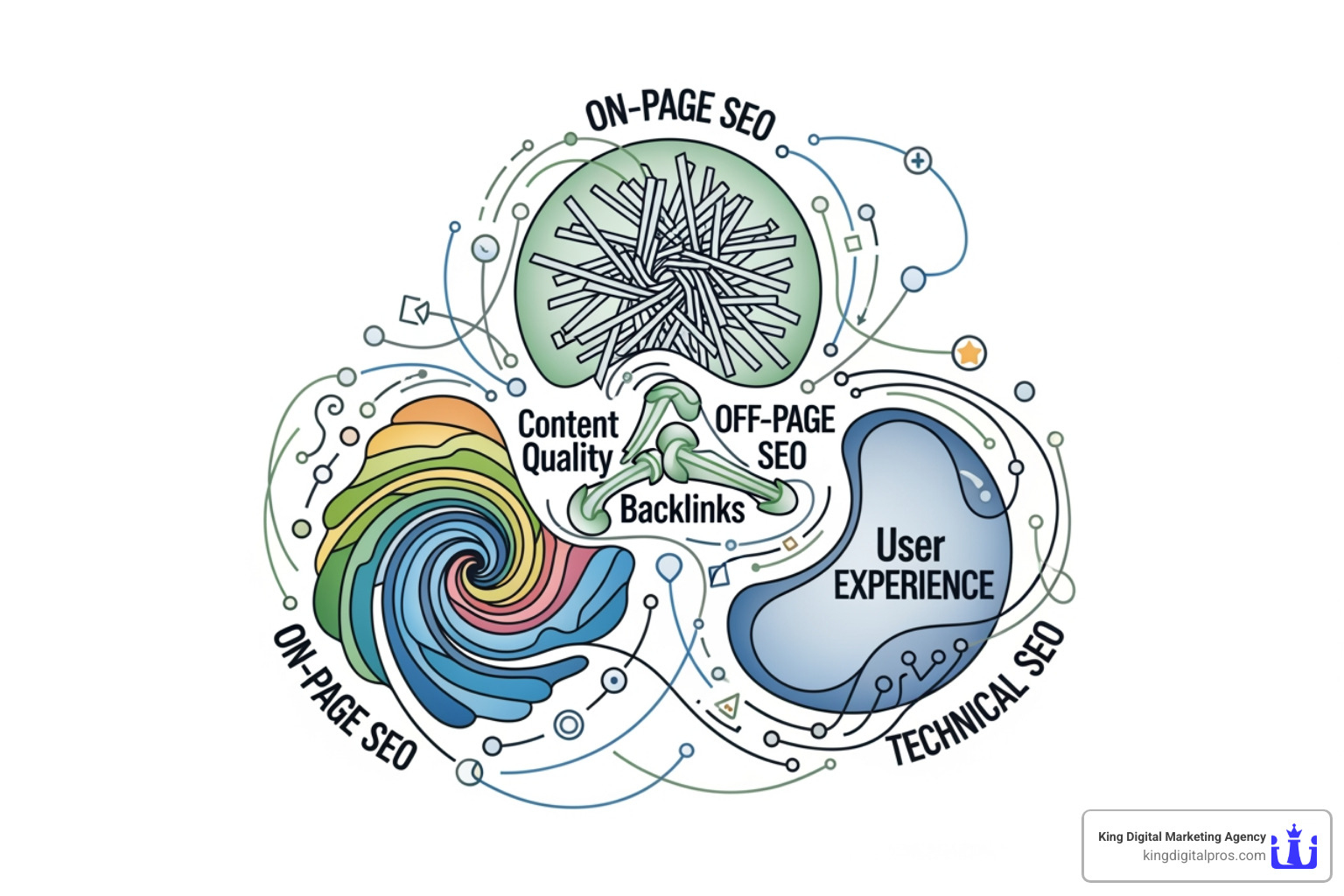
These strategies fall into three main categories: On-Page SEO (your content), Off-Page SEO (your authority), and Technical SEO (your site’s backend). Many of the principles below are also outlined in the official Google SEO starter guide and in educational resources such as Moz’s Beginner’s Guide to SEO.
1. Create High-Quality, Relevant, and Original Content
High-quality content is the bedrock of SEO. Google prioritizes “people-first content,” so your focus should be on creating material that genuinely helps your target audience. For businesses in New Mexico, this means:
- Answering User Questions: Create comprehensive content that answers the common questions your customers in Sandia Park or Grants ask. Our blog is a great example.
- Content Depth: Do not just skim the surface. If you are writing about “local attractions in Santa Fe,” make it the most thorough guide available.
- Originality: Google values unique insights. Conduct local surveys or offer a fresh perspective relevant to your service area to stand out.
- Avoiding Duplicate Content: Ensure every page offers unique, valuable content to avoid confusing Google and diluting your ranking potential.
Google’s Search Quality Evaluators look for trustworthy, original, and comprehensive content. Falling short can negatively impact your overall ranking.
2. Master On-Page and Technical SEO
Once you have great content, on-page and technical SEO help Google understand and surface it.
- Keyword Research: Identify the phrases your target audience in Albuquerque or Rio Rancho uses. Our Local Keyword Research Complete Guide offers more detail.
- Keyword Placement: Integrate keywords naturally into your title tags, meta descriptions, headers (H1, H2), image alt text, and URLs.
- Internal Linking: Link relevant pages within your site to help Google understand its structure and to pass authority between pages.
- Technical SEO: Ensure Google can efficiently crawl and index your site. This includes optimizing for site speed, mobile responsiveness, creating an XML sitemap, using a robots.txt file, and implementing schema markup to provide context.
For a deeper dive, see our guide on How to Create an SEO Friendly Website Design Structure.
3. Optimize for User Experience (UX) and Mobile
Google pays close attention to user experience. A happy user finds what they need quickly, which directly impacts your First page Google potential.
- Mobile-First Indexing: This is critical. Google primarily uses the mobile version of your site for ranking.
- Responsive Design: Your website must automatically adjust to any screen size.
- Page Speed (Core Web Vitals): Google measures page experience through metrics like loading speed and visual stability. Slow sites are at a disadvantage.
- Site Navigation: Your website should be intuitive and easy to steer.
- Readability: Use clear headings, short paragraphs, and readable fonts.
Our SEO Friendly Website Design services ensure your site meets these crucial standards.
4. Build Authority with High-Quality Backlinks
Backlinks are votes of confidence from other websites. When a reputable site links to you, it signals to Google that your page is valuable and authoritative.
- Earning Links: We focus on earning links by creating exceptional content that others want to reference, rather than “building” or buying links, which can lead to penalties.
- Methods: Strategies include guest blogging on reputable sites, digital PR to attract media attention, and claiming unlinked brand mentions.
- Quality Over Quantity: One link from an authoritative source like a local Chamber of Commerce is more valuable than dozens of low-quality links.
A strong backlink profile is a continuous process that significantly boosts your ability to improve search ranking.
The Local SEO Advantage: Dominating Your Geographic Area on the First Page of Google
For businesses in specific areas like Albuquerque, Rio Rancho, or Santa Fe, local SEO is your secret weapon for a First page Google spot. Local search is driven by proximity and immediate intent, especially with the growth of “near me” searches on mobile devices. When someone in Corrales searches for “auto repair shop,” they want a nearby, reputable business. Local SEO helps you appear in the Local Pack and on Google Maps.
Our Local SEO Best Practices guide offers a comprehensive look at these opportunities, and you can also refer to Google’s own Improve your local ranking on Google article for additional best practices.
How to Optimize Your Google Business Profile for the First Page of Google
Your Google Business Profile (GBP) is the most powerful free tool for local SEO. It is the hub that feeds Google Maps and the Local Pack, and a complete profile can get significantly more engagement than an incomplete one, as outlined in various industry case studies and in Google’s official guidance.
Here is how we optimize your GBP:
- Completeness: Fill out every section, including your business name, address, phone number (NAP), website, hours, and services.
- Consistent NAP: Ensure your name, address, and phone number are identical across all online listings to avoid confusing Google.
- Categories: Choose the most accurate and specific business categories.
- Photos and Videos: Regularly upload high-quality media of your storefront, team, and products to boost engagement.
- Google Posts: Use this feature to share updates, offers, and news directly in your search listing.
- Reviews: Encourage customer reviews and respond to every one – positive or negative – to build trust.
- Q&A Section: Monitor and answer questions to directly address customer queries.
Our team provides expert Google Business Listing Help to turn your profile into a powerful asset.
Using Localized Content and Location Pages to Rank
Beyond your GBP, your website content is crucial for local search. We strategically integrate local elements to signal your relevance to areas like Taos, Los Alamos, or Edgewood.
- City/Service-Area Pages: Create dedicated, optimized pages for each location you serve (for example, “Plumbing Services Rio Rancho”).
- Local Keywords: Naturally weave city names, neighborhoods, and regional landmarks into your website copy and blog posts.
- Local Proof: Feature testimonials and case studies from customers in specific New Mexico towns to add authenticity.
- Community Content: Create blog posts around local events or news to attract local traffic and show community connection.
Combining robust GBP optimization with localized content helps your business become the clear choice for nearby customers.
Your Questions Answered: The Path to Page One
Getting your business on the First page Google can feel daunting. Here are answers to some common questions.
How long does it typically take to see results from SEO efforts?
The honest answer is: it varies. SEO is a long-term investment, not a quick fix. While minor changes can have a fast impact, significant rankings take time. Factors include:
- Site Age: New websites take longer to build authority than established ones.
- Competition: Highly competitive keywords require more sustained effort.
- Website Health: Correcting technical issues or poor content takes time.
- Algorithm Updates: Google’s algorithm is always evolving, requiring continuous adaptation.
In general, many businesses start to see noticeable results within a period of several months. Industry surveys, such as those published by Ahrefs and similar SEO platforms, often cite windows of roughly 4 to 12 months depending on competition and effort. It is still not an exact science, but this provides a realistic planning horizon.
Can I just pay to be on the first page of Google?
Yes, through Google Ads (Pay-Per-Click or PPC). You can bid on keywords to have your ads appear at the top of the First page Google.
- Speed: PPC offers immediate visibility, which is useful for new launches or quick traffic boosts.
- Trust: Organic listings commonly receive far more clicks than paid ads because users tend to trust them more.
- Cost: You pay per click, and your visibility ends when you stop paying. Competitive keywords can be expensive.
A combined strategy of SEO and targeted PPC often yields the best results, using PPC for immediate traffic while your organic rankings mature. You can learn more about this approach through Google Ads.
What are some common SEO misconceptions to avoid?
To avoid wasting time or harming your ranking, steer clear of these myths:
- Keyword Stuffing: Do not cram content with keywords. Google discourages this practice. Write for humans first.
- Buying Backlinks: Buying low-quality links is a fast way to create risk for your site. Focus on earning natural, high-quality links.
- Meta Keywords Tag: Google Search has not used the keywords meta tag for ranking for years. Do not spend time on it.
- More Pages is Better: Quality is more important than quantity. A few high-quality pages will outperform many thin or duplicated ones. Low-quality content can hurt your entire site’s ranking.
- Ignoring Mobile: With mobile-first indexing, a non-mobile-friendly site is at a severe disadvantage. Mobile optimization is essential.
Conclusion: Your Journey to the Top of Google
Achieving a First page Google ranking for your New Mexico business is an achievable goal with the right strategy. Businesses that improve their online visibility often see meaningful growth in leads and revenue, as highlighted in many case studies and industry reports from organizations such as Search Engine Journal and Search Engine Land.
This guide covered the significance of page one, how Google’s algorithm works, and the core strategies for success: creating people-first content, mastering technical and on-page SEO, optimizing for mobile, and building authority with backlinks. For local businesses in Albuquerque, Rio Rancho, or Santa Fe, a well-optimized Google Business Profile is paramount.
SEO is a long-term commitment, but the rewards of increased visibility, credibility, and qualified leads are substantial. While SEO builds authority, a combined strategy with targeted advertising can accelerate results and maximize visibility on the first page of Google.
At King Digital Marketing Agency, we help local businesses thrive in the digital landscape. We have the expertise to steer Google’s complexities and support your climb toward the top so that your ideal customers can find you when they need you most.