
Copy Writing Emails: Master 4 Keys to Success
Why Email Copywriting is Your Most Powerful Marketing Tool
Copy writing emails is the strategic craft of writing persuasive text for marketing emails – from subject lines to calls-to-action – designed to drive opens, clicks, and conversions. It combines audience understanding, compelling storytelling, and proven psychological triggers to turn email subscribers into paying customers.
Key Components of Effective Email Copywriting:
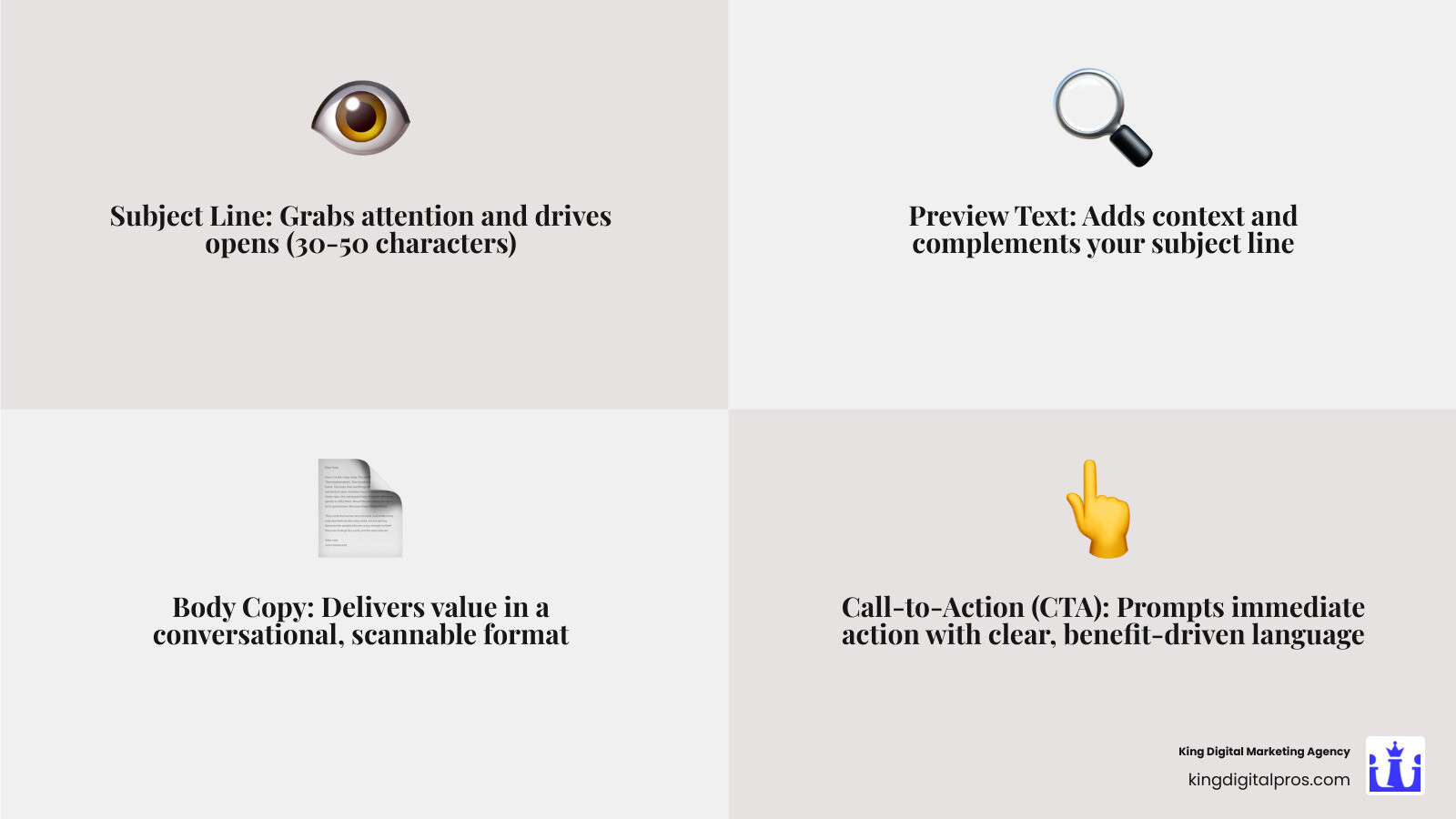
- Subject Line – Grabs attention and drives opens (30-50 characters)
- Preview Text – Adds context and complements your subject line
- Body Copy – Delivers value in a conversational, scannable format
- Call-to-Action (CTA) – Prompts immediate action with clear, benefit-driven language
Email marketing delivers an incredible ROI of $42 for every $1 spent, making it one of the most profitable marketing channels available. Yet many local business owners struggle to write emails that actually get opened, read, and acted upon. The difference between emails that convert and those that get deleted comes down to one thing: the quality of your copy.
Whether you’re announcing a new service, following up with leads, or re-engaging past customers, your words matter. Compelling email copy builds trust, nurtures relationships, and guides prospects through your sales funnel – all without requiring expensive ad spend or complex technical skills.
Handy copy writing emails terms:
The Foundation: What is Email Copywriting and Why It Matters
At its core, email copywriting is the art of writing persuasive words for marketing emails to get people to open, read, and take action. The goal is to guide your audience toward a specific outcome, like making a purchase or visiting your store in Albuquerque. Email offers a direct line to customers with an incredible ROI of $42 for every dollar spent, outperforming many other channels. For local businesses in Rio Rancho or Santa Fe, effective copy writing emails builds trust and drives growth. The copy itself is what captures attention and moves customers along their journey; without it, even the best-designed email fails.
For more insights into how we craft persuasive messages, explore our Copywriting Services.
The Subject Line: Your First Impression
The subject line is your email’s gatekeeper, determining if it gets opened or deleted. A compelling subject line is your first and best chance to make an impression. To make it powerful, we focus on these strategies:
- Curiosity and Urgency: Phrases like “sneak peek” or “limited-time offer” create FOMO (Fear of Missing Out) and encourage immediate action.
- Personalization: Using a recipient’s name or referencing past behavior significantly increases open rates.
- Numbers and Statistics: Subject lines with numbers stand out and provide concrete information, boosting open rates by up to 57%. “5 Ways to Boost Your Business” is more effective than “Ways to Boost Your Business.”
- Emojis (Used Wisely): Emojis add personality but should align with your brand voice and audience.
- Conciseness: Aim for 30-50 characters to ensure full visibility on mobile devices, where longer subject lines get cut off.
Think of it this way: your subject line is your email’s headline. It needs to grab attention and promise value in a snapshot.
The Preview Text: The Supporting Act
If the subject line is the headline, the preview text is the sub-headline. This short snippet appears after the subject line in most inboxes, offering more context to entice readers. Many email clients pull the first few words of your email if you don’t set custom preview text, which can result in unhelpful phrases like “View this email in your browser.” We craft engaging preview text that:
- Adds Context: Expands on the subject line. If the subject is “Big Sale This Weekend!”, the preview could be “Up to 50% off all items – don’t miss out!”
- Creates Intrigue: Piques curiosity without giving everything away.
- Reinforces Value: Highlights a key benefit or offer.
Like subject lines, keeping preview text mobile-optimized is crucial, as its visible length varies across devices.
The Body Copy: The Heart of Your Message
Once the email is open, the email body copy must deliver on the subject line’s promise. This is where you build rapport and guide the reader. Effective body copy feels like a conversation, which is vital for local businesses in communities like East Mountains where personal relationships matter. Here are our best practices:
- Value Proposition: Clearly communicate what’s in it for the reader. What problem are you solving?
- Brand Voice: Maintain a consistent tone that reflects your brand’s personality.
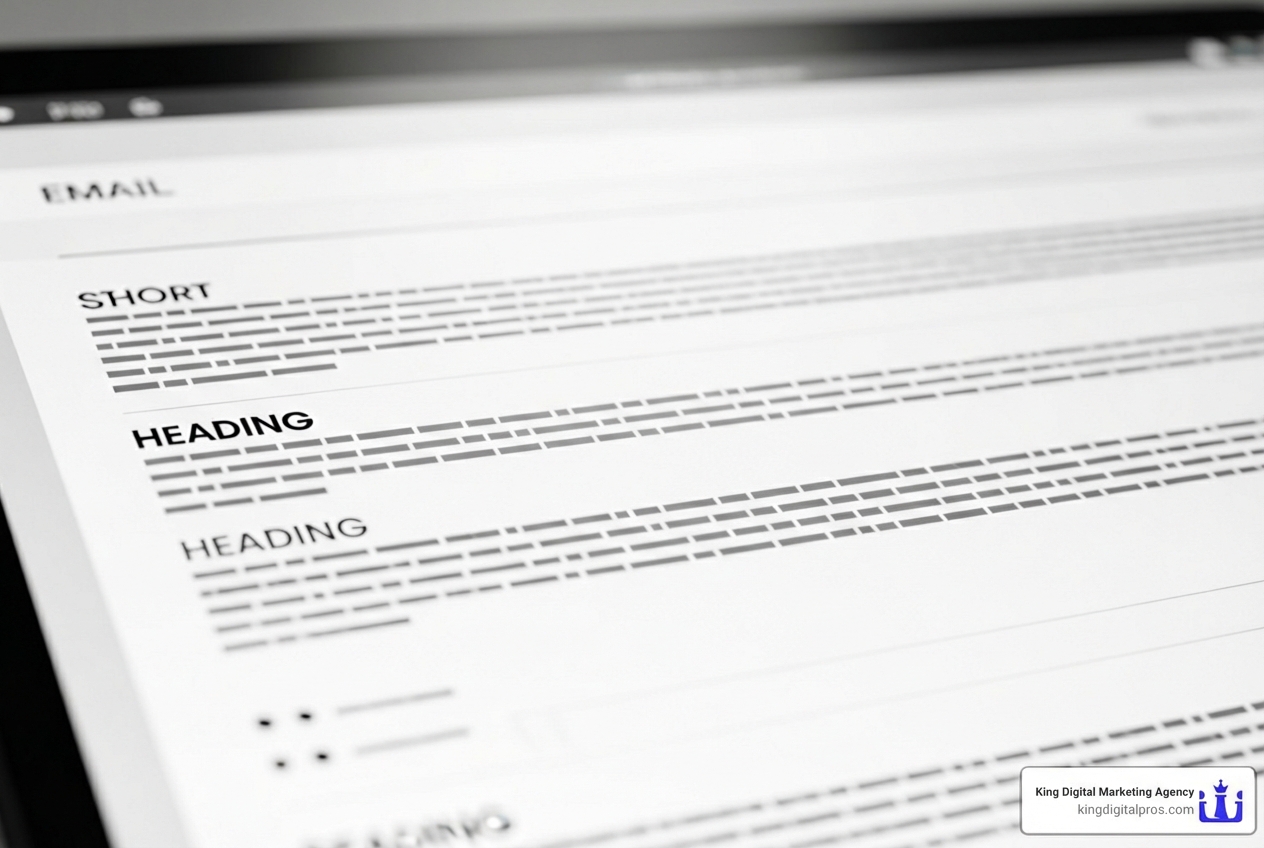
- Scannability: Mobile readers scan emails quickly. Make your copy easy to digest using:
- Short Paragraphs: Break up text into small chunks.
- Bullet Points and Lists: Organize information and make key points stand out.
- White Space: Prevents your email from looking overwhelming.
- Headings: Guide the reader’s eye.
- Engaging Language: Use analogies and sensory words to paint a vivid picture.
The meditation app Calm is known for its scannable email copy, using short sections and ample white space for an easy-to-read experience.
The Call to Action (CTA): The Final Push
The Call to Action (CTA) tells your reader what to do next. A great CTA is clear and compelling. Ideally, each email should have one primary goal and a single, strong CTA. To create a CTA that drives action, focus on:
- Action-Oriented Language: Use strong verbs like “Shop Now,” “Learn More,” or “Get Your Free Quote.”
- Benefit-Driven Copy: Frame the action around what the reader gains. “Get Your Free Guide” is better than “Download.”
- Button Design: Use contrasting colors and ensure the button is large enough for mobile tapping (at least 44×44 pixels).
- Strategic Placement: Place your CTA where it’s easily seen, like above the fold.
Personalized CTAs convert over 200% better than generic ones. For a local business in Taos, a CTA could be “Book Your Appointment Today!” Let us help you Boost Conversion Rates.
Crafting Compelling Copy: Techniques for Emails That Convert
With the foundational elements in place, we can now dive into the techniques that lift your emails from merely functional to truly compelling. This is where we connect with your audience on a deeper level, building emotional ties and guiding them effortlessly towards conversion. It’s about understanding the human element behind the inbox, whether they’re a potential customer in Corrales or an existing client in Grants.
Know Your Audience and Address Their Pain Points
The secret to effective email copy is knowing your audience. This means understanding their motivations, desires, and pain points. We dig deep by:
- Creating Buyer Personas: Detailed profiles of your ideal customers help us understand their goals and challenges.
- Using Voice of Customer (VOC) Data: We gather insights from surveys, reviews, and social media. Using their exact language helps craft messages that resonate.
- Empathy Mapping: Stepping into your customers’ shoes helps us anticipate their concerns.
When we address pain points, our emails become solutions. For a plumbing service in Edgewood, an email about “avoiding costly winter pipe bursts” speaks to a local concern. To find what your audience cares about, explore platforms like Quora and Reddit for unfiltered insights.
Master the Art of Storytelling and Personalization
Humans are hardwired for stories. Storytelling in email copy builds emotional connections and makes your brand memorable. Instead of listing features, we create a narrative, such as:
- Brand Origin Stories: How did your business in Sandia Park begin?
- Customer Success Stories: Share testimonials or case studies showing how you helped a customer.
- Product Journeys: Describe the care that goes into your offerings.
By creating a narrative, you make emails more engaging. Personalization is also key. Beyond using a first name, we leverage:
- Behavioral Personalization: Emails based on actions like abandoned carts or past purchases.
- Dynamic Content: Tailoring email sections to individual segments.
- Location-Based Offers: Sending relevant promotions to clients in Tijeras.
Personalization makes emails feel like a one-on-one conversation, which is crucial to Attract More Customers.
Proven Copywriting Formulas for Structuring Your Message
While creativity is key, structure provides a backbone for effective copy writing emails. Proven copywriting formulas help organize your message and guide the reader.
-
PAS (Problem, Agitate, Solve):
- Problem: Identify a specific pain point.
- Agitate: Expand on the problem and its negative consequences.
- Solve: Introduce your product or service as the solution. This is effective for problem-aware audiences.
-
4 P’s (Promise, Picture, Proof, Push):
- Promise: Make a bold claim about what you can do.
- Picture: Help the reader visualize enjoying the benefits.
- Proof: Provide evidence (testimonials, data) to back up your claim.
- Push: Tell them what to do next.
-
AIDA (Attention, Interest, Desire, Action):
- Attention: Grab the reader with a compelling hook.
- Interest: Build interest by highlighting benefits.
- Desire: Explain how your offering will improve their life.
- Action: Provide a clear call to action.
These formulas are flexible guides that help ensure your message is logical and persuasive.
Leveraging Social Proof and Creating Irresistible CTAs
Social proof is a powerful tool that uses the experiences of others to build trust. For a business in Santa Fe, seeing positive local feedback can be a significant motivator. We integrate social proof through:
- Testimonials: Short, impactful quotes from satisfied customers.
- User Reviews: Highlighting star ratings and review snippets.
- Case Studies: Detailed accounts of customer success.
- Numbers: Mentioning how many customers you’ve served or products sold.
When combined with strong CTAs, social proof makes offers hard to resist. Make your CTAs irresistible by using:
- Action Verbs: Use dynamic words like “Shop,” “Find,” or “Join.”
- Urgency: Create immediacy with words like “Now,” “Today,” or “Limited Time.”
- Exclusivity: Make readers feel special with phrases like “Claim Your Spot.”
The goal is to make clicking an easy and exciting decision.
Optimizing and Refining Your Copy Writing Emails Strategy
Great email copywriting isn’t a one-time effort; it’s a continuous process of learning, testing, and refining. Just as a chef constantly tastes and adjusts a recipe, we continuously optimize our email strategies to ensure maximum impact. This involves data-driven decisions, technical considerations, and a relentless focus on user experience. For a comprehensive look at improving your conversion rates, check out our Conversion Optimization Complete Guide.
The Role of A/B Testing in Perfecting Your Copy
A/B testing, or split testing, is our secret weapon for perfecting email copy. It involves comparing two versions of an email (A and B) to see which performs better. This scientific approach shows what resonates with your audience. We routinely test:
- Subject Lines: Different hooks, lengths, and personalization.
- Calls to Action (CTAs): Button text, colors, and placement.
- Copy Length and Tone: Short vs. long copy, or humorous vs. serious tones.
- Personalization: Different levels of personalization to find what feels authentic.
By analyzing metrics such as Open Rate, Click-Through Rate (CTR), and Conversion Rate, we gain invaluable insights. This data allows us to make informed decisions, ensuring every campaign is more effective than the last.
Plain-Text vs. HTML: Choosing the Right Format
The format of your email can significantly impact your copywriting strategy. We often weigh the pros and cons of plain-text versus HTML emails, as each serves a different purpose.
| Feature | Plain-Text Emails | HTML Emails |
|---|---|---|
| Appearance | Simple, resembles a standard personal email | Visually rich, uses images, branding, custom fonts, layouts |
| Loading Speed | Very fast | Can be slower due to images and complex code |
| Deliverability | Generally higher, less likely to trigger spam filters | Can be lower if poorly coded or image-heavy |
| Mobile Friendly | Inherently responsive | Requires careful design and coding to be responsive |
| Tone | Personal, conversational, authentic | Professional, branded, engaging, can feel more “marketing-y” |
| Tracking | Limited without special tools | Robust tracking capabilities for opens, clicks, etc. |
A well-written, plain-text email can feel more genuine and often performs as well as a highly-designed HTML email. Plain-text is ideal for personal communications, while HTML is excellent for showcasing products and branding in newsletters or promotions. The choice depends on your goal, brand, and audience.
Best Practices for Mobile-First Email Copy Writing Emails
With over 55% of emails opened on mobile devices, a mobile-first approach to copy writing emails isn’t just a best practice – it’s a necessity. Mobile readers scan quickly, so readability is paramount. Here’s how we optimize for the small screen:
- Scannable Layout: Use short paragraphs (1-3 sentences), bullet points, and bold text to highlight key information.
- Short Sentences: Break down complex ideas into simple, concise sentences.
- Readable Font: Use at least 14px for body text and clean, sans-serif fonts like Arial or Verdana.
- Clickable CTAs: Make buttons large and easy to tap (minimum 44×44 pixels).
- Minimal Scrolling: Place your most important information and CTA early in the email.
Designing for mobile ensures your message is clear and actionable, no matter where your audience is reading it, from Los Alamos to Grants.
Common Mistakes in Email Copy Writing Emails to Avoid
Even seasoned marketers can fall into common traps. Avoiding these pitfalls is crucial for engagement and a positive brand image. We steer clear of:
- Spam Trigger Words: Avoid excessive use of terms like “free,” “win,” or “guarantee” in subject lines.
- ALL CAPS and Excessive Punctuation: This comes across as shouting and can seem spammy. Use multiple exclamation marks sparingly.
- Vague CTAs: Be specific. Instead of “Click Here,” tell the reader what benefit they’ll receive.
- Inconsistent Messaging: Ensure continuity between your subject line, email body, and landing page to avoid confusion.
- Ignoring Segmentation: A one-size-fits-all approach rarely works. Tailor your content to different audience segments.
- Forgetting the Unsubscribe Link: This is a legal requirement (CAN-SPAM Act). Make it easy for people to unsubscribe to avoid spam complaints, which hurt your sender reputation.
Avoiding these mistakes helps ensure your emails land in the inbox and drive results.
Frequently Asked Questions about Email Copywriting
How do you start email copywriting?
Starting with email copywriting improves with practice and a structured approach. Here’s how to begin:
- Understand Your Audience: Who are you talking to? What are their needs and pain points? This is foundational.
- Learn Marketing Basics: Familiarize yourself with persuasion, value propositions, and the customer journey.
- Study Successful Examples: Analyze emails from brands you admire. Look at their subject lines, body copy, and CTAs.
- Practice Writing: Experiment with welcome emails, promotional emails, and newsletters.
- Build a Portfolio: Create mock-up emails to showcase your work.
- Use Tools to Refine Copy: Leverage grammar checkers like Grammarly to ensure your copy is clear and error-free.
The goal is to get people to open, read, and take action. Focus on clarity and value.
What is the difference between email copywriting and content writing?
While both involve writing, email copywriting and content writing have different primary goals.
- Email Copywriting: The main objective is to drive immediate action or conversion. It’s persuasive writing designed to move the reader toward a specific goal, like making a purchase or clicking a link. It’s often direct and relies on strong CTAs.
- Content Writing: This focuses on long-term engagement, education, and building brand authority. This includes blog posts, articles, and guides. The goal is to provide value and inform, attracting an audience over time.
Think of it this way: email copy is a salesperson guiding a decision, while content is an expert sharing valuable information. At King Digital, our services encompass both. Learn more about our approach with our Content Writing Business insights.
What are some industry-specific use cases for email copywriting?
Email copywriting is versatile and can be adapted to almost any industry, helping local businesses across New Mexico. Here are a few examples:
- Ecommerce: Promoting new products, announcing sales, and sending abandoned cart reminders.
- SaaS (Software as a Service): Onboarding new users, sharing product updates, and nurturing leads.
- Real Estate: Sharing new property listings in Albuquerque, sending market updates for Santa Fe, and inviting prospects to open houses. For specialized needs, see our Real Estate Copywriting services.
- Non-profits: Communicating with donors, sharing impact stories, and promoting fundraising events.
- Healthcare: Sending appointment reminders, sharing health tips, and promoting new services.
- Travel and Hospitality: Promoting travel deals, sending booking confirmations, and sharing destination guides.
- Retail (Brick-and-Mortar): Announcing in-store sales and inviting customers to local events in Rio Rancho.
In each case, the principles of understanding the audience, delivering value, and using a clear CTA remain constant.
Conclusion
Mastering copy writing emails is no longer optional; it’s a critical skill for any business aiming to thrive in the digital landscape. We’ve explored the foundational elements – from crafting irresistible subject lines and supportive preview text to developing engaging body copy and compelling calls to action. We’ve also digd into advanced techniques, emphasizing the power of knowing your audience, leveraging storytelling and personalization, employing proven copywriting formulas, and using social proof.
The journey to effective email marketing is one of continuous improvement, guided by A/B testing and an understanding of different email formats and mobile-first design. By avoiding common mistakes and focusing on an audience-centric, value-driven approach, your emails can transform from mere messages into powerful conversion tools.
For businesses seeking to master their digital communication and open up the full potential of their email marketing, King Digital provides expert guidance and custom solutions. We’re dedicated to helping local businesses across Albuquerque, Rio Rancho, Santa Fe, and beyond, turn their email subscribers into loyal, revenue-generating customers.
Learn more about our professional Copywriting Services.
