

Business blog writing: 2026 Ultimate Growth Guide
Why Your Blog is Your Most Powerful Marketing Tool
Business blog writing is the practice of creating educational content to attract customers, build authority, and drive organic traffic. Key principles include:
- Write for your audience: Address their pain points and questions, not just your products.
- Prioritize quality: In-depth, valuable posts always outperform rushed content.
- Optimize for SEO: Use relevant keywords, clear headings, and internal links.
- Be consistent: Regular publishing builds audience trust.
- Use clear calls-to-action (CTAs): Guide readers to the next step.
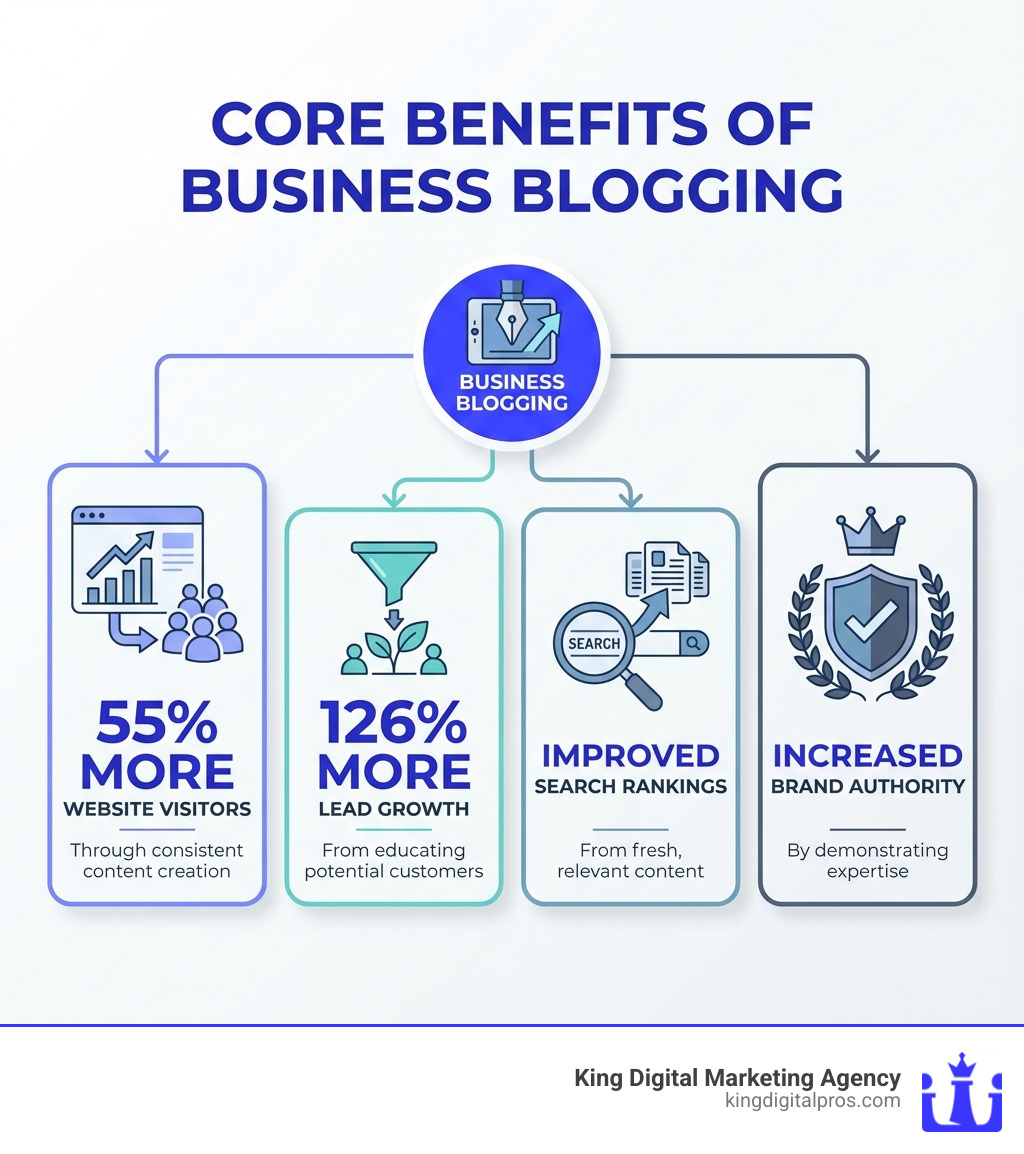
The numbers don’t lie. Small businesses that blog get 55 percent more website visitors and 126 percent more lead growth than those without one. Every post creates a new opportunity for customers to find you through Google.
But staring at a blank page is overwhelming. What should you write about? How do you stand out?
The good news is that effective blogging isn’t about being a marketing genius. It’s about understanding your audience, solving their problems, and being consistent. Do that, and your blog becomes your hardest-working marketing tool.
I’m Bernadette King, founder of King Digital Marketing Agency, and I’ve spent my career helping businesses transform their online presence with strategic business blog writing and SEO. I’ve seen how the right blogging approach turns website visitors into loyal customers.
The Strategic Foundation: Why Your Business Needs a Blog
A business blog’s primary purpose is to attract customers with valuable content. It builds brand awareness, establishes industry authority, and generates qualified leads. Think of it as a digital storefront for your expertise, where people find answers and get to know your brand without a sales pitch.
Content marketing, with blogging at its heart, is a fundamental strategy for growth. A study from Orbit Media reinforces that the majority of bloggers find that blogging drives effective results. For small businesses in communities like Albuquerque and Santa Fe, a blog levels the playing field, helping you connect with your target audience. To learn more, explore our resources on growing your local business.
Key Benefits for Your Small Business
Let’s explore the tangible advantages of a well-maintained blog:
-
Increased Website Visitors: Each new blog post is another indexed page on your site, creating more opportunities to appear in search results. This increases your chances of ranking for relevant keywords, driving more traffic. Small businesses that blog get 55 percent more website visitors.
-
More Qualified Leads: Active blogs generate 67% more leads per month. By addressing specific pain points, you attract the right traffic-people already interested in your offerings. A call-to-action (CTA) in each post can convert these readers into leads.
-
Improved Trust with Audience: Consumers buy from brands they trust. A blog lets you share your expertise and values, building a relationship with your audience. Consistent, valuable content establishes you as a credible resource, which also helps improve search rankings.
-
Humanizing Your Company: A blog gives your business a personality. Share stories about your team, your work, and your community involvement (like supporting local charities in Grants or Los Alamos) to become more relatable and trustworthy.
-
Educating the Market: A blog is perfect for educating your market about your solutions. Explain complex topics simply to guide potential customers through their decision-making journey, positioning your business as a thought leader.
Blog Writing vs. Website Copywriting
Don’t confuse business blog writing with website copywriting. They serve distinct but crucial purposes in your digital marketing strategy.
Here’s a simple comparison:
| Feature | Business Blog Writing | Website Copywriting |
|---|---|---|
| Primary Goal | Inform, Educate, Build Authority, Connect | Persuade, Sell, Drive Immediate Action |
| Length | Long-form (typically 500-2000+ words), in-depth | Short-form, succinct, scannable |
| Tone | Conversational, friendly, empathetic, educational | Action-oriented, direct, benefit-focused, persuasive |
| Focus | Answering questions, solving problems, sharing insights | Highlighting product/service features, benefits, CTAs |
| SEO Approach | Long-tail keywords, topic clusters, content depth | Specific keywords, clear value proposition |
| Sales Cycle | Supports longer B2B sales cycles, nurtures leads | Facilitates quick conversions, addresses immediate needs |
In short, blog writing builds relationships through education (e.g., a Santa Fe landscaper blogging about drought-tolerant plants), while website copywriting drives immediate action with persuasive, benefit-focused language. Both are vital for achieving your business goals. If you need help with persuasive messaging, check out our copywriting services.
Defining Your Audience and Niche
To create resonant content, you must define your audience and niche. General content is weak; specific content is powerful.
-
Buyer Personas: Create detailed buyer personas-semi-fictional profiles of your ideal customers based on research and data. Understand their demographics, motivations, and goals. For example, a Corrales business might target local agricultural businesses. The narrower the persona, the better.
-
Customer Pain Points: Effective content solves customer pain points. What are their challenges and questions? As Neil Patel says, understand the ‘why’ behind their search. For example, an Edgewood business could address “Common HVAC Issues in High Desert Climates” to meet a specific local need.
-
Content Segmentation: Use a content segmentation grid to align topics with specific personas. This ensures every piece of content serves a strategic purpose in generating qualified prospects.
-
User Intent: Meeting user intent is paramount for modern SEO. Google prioritizes content that satisfies the ‘why’ behind a search. Focusing on this helps you create content that ranks well and genuinely helps your audience, which is key to attracting more local customers.
Crafting Compelling Content: The Art of Business Blog Writing
With your strategy and audience defined, it’s time to craft compelling content. Effective business blog writing is relevant, authoritative, and easy to scan. It should tell a story and simplify complex ideas for an audience with a short attention span.

Essential Elements of Effective Business Blog Writing
Every well-written post shares these key characteristics:
- Strong Headline: Your first impression must be compelling, make a promise, and include keywords.
- Engaging Introduction: Hook readers immediately by stating what the post covers and why it matters to them.
- Valuable Body Content: The body of your post must provide value. Solve problems, offer actionable tips, and break down complex topics. A solar installer in Taos, for instance, could create a guide to panel efficiency.
- Clear Subheadings: Use subheadings to break up text and improve readability for scanners.
- Strong Conclusion: Summarize your main points and reiterate the post’s value.
- Call-to-Action (CTA): End with a clear CTA to guide the reader’s next step, like subscribing, reading a related article, or contacting you. Diverse CTAs are highly effective.
Writing Irresistible Headlines
Your headline is the gatekeeper; it determines whether someone clicks. Use these strategies for headlines that demand attention:
- Using Numbers and Lists: Headlines like “5 Ways to Boost Your Local SEO” or “10 Tips for Small Business Owners in Tijeras” are effective because they promise a clear, structured takeaway.
- Asking Questions: Engage your audience directly with questions like “Is Your Business Ready for Local SEO?” to imply you have the answer.
- Creating Curiosity: Intrigue readers with headlines that hint at a solution, such as “The Secret to Doubling Your Website Traffic in New Mexico.”
- Incorporating Keywords: Strategically placing your main keyword in the headline helps with SEO and signals relevance.
- Action Verbs: Use strong verbs to make headlines dynamic, like “Master Business Blog Writing: Open up Your Growth Potential.”
The Power of Visuals in Business Blogging
Visuals are essential in content-saturated marketing. They break up text, increase engagement, and convey complex information quickly, making posts more digestible.

- Breaking Up Text: Images and infographics provide visual relief and prevent reader fatigue.
- Increasing Engagement: Visuals capture attention faster than text. According to a Wyzowl survey, popular marketing videos include testimonials (39%) and explainers (38%).
- Using Images, Infographics, and Charts: Use high-quality, relevant visuals to illustrate points and simplify data. Always use descriptive alt text with keywords for accessibility and SEO.
Tone and Style in Business Blog Writing
Your blog’s tone and style are crucial for connecting with your audience. A blog allows for a more personable, conversational approach than formal business communications.
- Finding Your Brand Voice: Develop an authentic voice that reflects your brand’s personality-be it witty, serious, or educational-and use it consistently.
- Conversational vs. Formal: A conversational tone is usually best. It makes content approachable and feels like a dialogue with an expert. Address the reader directly using “you.”
- Writing with Empathy: Write with empathy. Show you understand and care about your readers’ problems to craft messages that resonate.
- Consistency Across Posts: While topics may vary, your overarching tone should remain consistent to reinforce your brand identity.
For help crafting your brand’s voice, consider our specialized copywriting services.
Maximizing Your Reach: SEO and Promotion Strategies
Great content is only half the battle. To reach your target audience, you need a robust SEO and promotion strategy. This means actively sharing, repurposing, and optimizing your content long after you hit “publish.”
Using Your Blog to Improve SEO Rankings
Your blog is a powerful SEO asset, especially for local businesses in New Mexico. Each post is a chance to improve your visibility and attract organic traffic.
- Keyword Research: This is the foundation. Use tools like Google Keyword Planner or Ahrefs to find what your audience is searching for. Focus on long-tail keywords with location-specific terms (e.g., “best water heater repair in Albuquerque”) to attract highly relevant local leads.
- On-Page SEO: Integrate keywords naturally into your title, subheadings (H1, H2), and introduction. Google ranks value and problem-solving content, not just keyword density.
- Internal Linking: Link to other relevant pages and posts on your site. This improves user navigation and signals content depth to search engines, boosting SEO.
- Meta Descriptions: Craft compelling meta descriptions that include your main keyword and a CTA to encourage clicks from search results.
- Building Backlinks: High-quality content naturally attracts backlinks from other reputable sites, which is a strong authority signal for search engines.
- SEO-Led Blog Posts: An SEO-led blog post is strategically designed to rank on Google by balancing storytelling with optimization techniques for maximum visibility.
For a deeper dive, check our guide on how to improve your search ranking and consult Google’s SEO Starter Guide.
Effective Strategies for Promoting Blog Content
Once your post is live, promote it to maximize its reach:
- Social Media Platforms: Share your posts on the channels where your audience is active. Use compelling teasers and include share buttons on your blog.
- Email Marketing: Promote new posts to your email list. Use strong subject lines and a snippet of the article to entice clicks. Email marketing has an excellent ROI, with returns of $36 to $42 for every dollar spent.
- Online Communities: Genuinely share your insights in relevant online forums and groups, like local Facebook groups or industry-specific LinkedIn groups.
- Influencer Outreach: If your content mentions an industry leader, reach out. They might share it with their audience.
- Content Repurposing: Repurpose your blog posts into other formats to extend their reach:
- Turn key points into social media graphics or short videos.
- Create an infographic from your data.
- Develop a podcast episode or webinar on the topic.
Maintaining a Consistent Blogging Schedule
Consistency is the cornerstone of a successful blog. It builds audience anticipation and signals to search engines that your site is active.
- Content Calendar: Use a content calendar to plan posts two to three months in advance. This ensures a steady flow of new material and keeps your strategy on track.
- Batching Content: Improve efficiency by dedicating blocks of time to brainstorming, writing, and scheduling multiple posts at once.
- Setting Realistic Goals: One to three high-quality posts per week is an effective frequency for most small businesses. Consistency is more important than volume.
- Staying One Month Ahead: Try to stay one month ahead on content creation. This buffer prevents interruptions to your publishing schedule if unexpected issues arise.
A consistent schedule, paired with regular website maintenance, keeps your digital presence robust.
Measuring Success and Managing Costs
Like any business investment, your blog must deliver measurable results. Tracking performance helps you understand what’s working and how to optimize your efforts.
How to Measure Your Blog’s Performance
Measure your blog’s impact by tracking these key performance indicators (KPIs):
- Tracking Organic Traffic: Use Google Analytics and Search Console to track organic traffic. Monitor page views, unique visitors, and time on page to see how many people find your blog via search.
- Monitoring Bounce Rate: A high bounce rate may indicate your content isn’t meeting user expectations. Aim to keep readers engaged beyond the first page.
- Measuring Conversion Rates: Track how many readers complete a desired action (e.g., newsletter signup, contact form). Active blogs generate 67% more leads per month.
- Tracking Reader Engagement: Monitor reader engagement through comments, social shares, and inbound links. These metrics show your content is providing value.
- Using Google Analytics: This indispensable free tool provides data on traffic sources, popular content, and demographics to inform your strategy. Learn more at the Google Analytics Academy.
Regularly reviewing these metrics allows you to refine your business blog writing strategy for better results.
The Costs of Maintaining a Business Blog
Investing in a blog comes with costs that vary based on your approach:
- In-house Team vs. Freelancers vs. Agency:
- In-house Team: Offers control but is the most expensive option, with an average content marketer salary around $95,958 annually, per Superpath’s report.
- Freelancers: A flexible and affordable option, but requires strong management to ensure quality and consistency. Costs vary widely.
- Agency: Offers a scalable, hands-off team of experts in writing, SEO, and strategy. Costs can range from $5,000 to over $30,000 per month.
- Content Creation Costs: Costs depend on article length, complexity, and research required.
- Subject Matter Expert (SME) Fees: For specialized industries, you may need to pay SMEs to write or validate content, ensuring accuracy and trust.
- Tool Subscriptions: Budget for essential tools for keyword research, grammar checking, and project management.
View your blog as an investment that yields returns in traffic, leads, and authority. Budget accordingly, aiming for profitability within 6-12 months.
Frequently Asked Questions about Business Blogging
Here are answers to common questions businesses have about blogging.
How often should a business post on its blog?
Consistency is more important than frequency. For most small businesses, one to two high-quality posts per week is an effective and manageable goal. This provides a steady stream of new content for search engines and your audience. Focus on quality over quantity; one great post is better than five rushed ones. You can adjust your schedule later based on performance analytics.
How long should a business blog post be?
While there’s no magic number, longer content (1,000+ words) generally performs better in search for comprehensive topics and in-depth guides. Shorter posts (300-500 words) can work for quick updates. The most important rule is to answer the user’s query completely without adding fluff. Let the topic dictate the length, not an arbitrary word count.
How do you encourage reader interaction on a blog?
Building a community requires interaction. Encourage it by:
- Asking open-ended questions at the end of your posts to invite comments.
- Responding to all comments to show you value reader input and foster community.
- Using interactive elements like polls or quizzes.
- Including clear social sharing buttons to make sharing easy.
- Featuring reader comments or questions in future content to make your audience feel heard.
Turning your blog into a two-way conversation builds loyalty and turns readers into brand advocates.
Conclusion: Turn Your Blog into a Growth Engine
We’ve covered the essentials of business blog writing, from strategy and creation to SEO and measurement. While it’s a long-term commitment-often taking 6-12 months to see significant traction-a well-executed blog is a powerful engine for traffic, leads, and brand trust. It’s one of the most sustainable marketing strategies for local businesses in New Mexico.
At King Digital Marketing Agency, our expertise in SEO-driven content helps businesses turn their blogs into growth engines. We understand how to create content that resonates with local audiences and ranks in search results.
Don’t let the blank page intimidate you. With the right strategy, your blog can become your most powerful marketing asset. Ready to transform your online presence? Get professional copywriting help and let’s write your success story.
