Boost Local Visibility: 2025’s Ultimate Guide
Why Local Visibility is Critical for Your Business Success
Boost local visibility is the key to turning online searches into real customers walking through your door. When potential customers search for businesses like yours, you need to show up – and show up first.
How to Boost Local Visibility (Quick Answer):
- Claim and optimize your Google Business Profile – Complete every section with accurate information, photos, and regular updates
- Ensure NAP consistency – Keep your Name, Address, and Phone Number identical across all online platforms
- Generate customer reviews – Ask satisfied customers for reviews and respond to all feedback promptly
- Optimize your website – Use local keywords, create location pages, and ensure mobile-friendliness
- Build local citations – Get listed in relevant directories and maintain accurate information everywhere
- Create community content – Share local news, events, and stories that connect with your audience
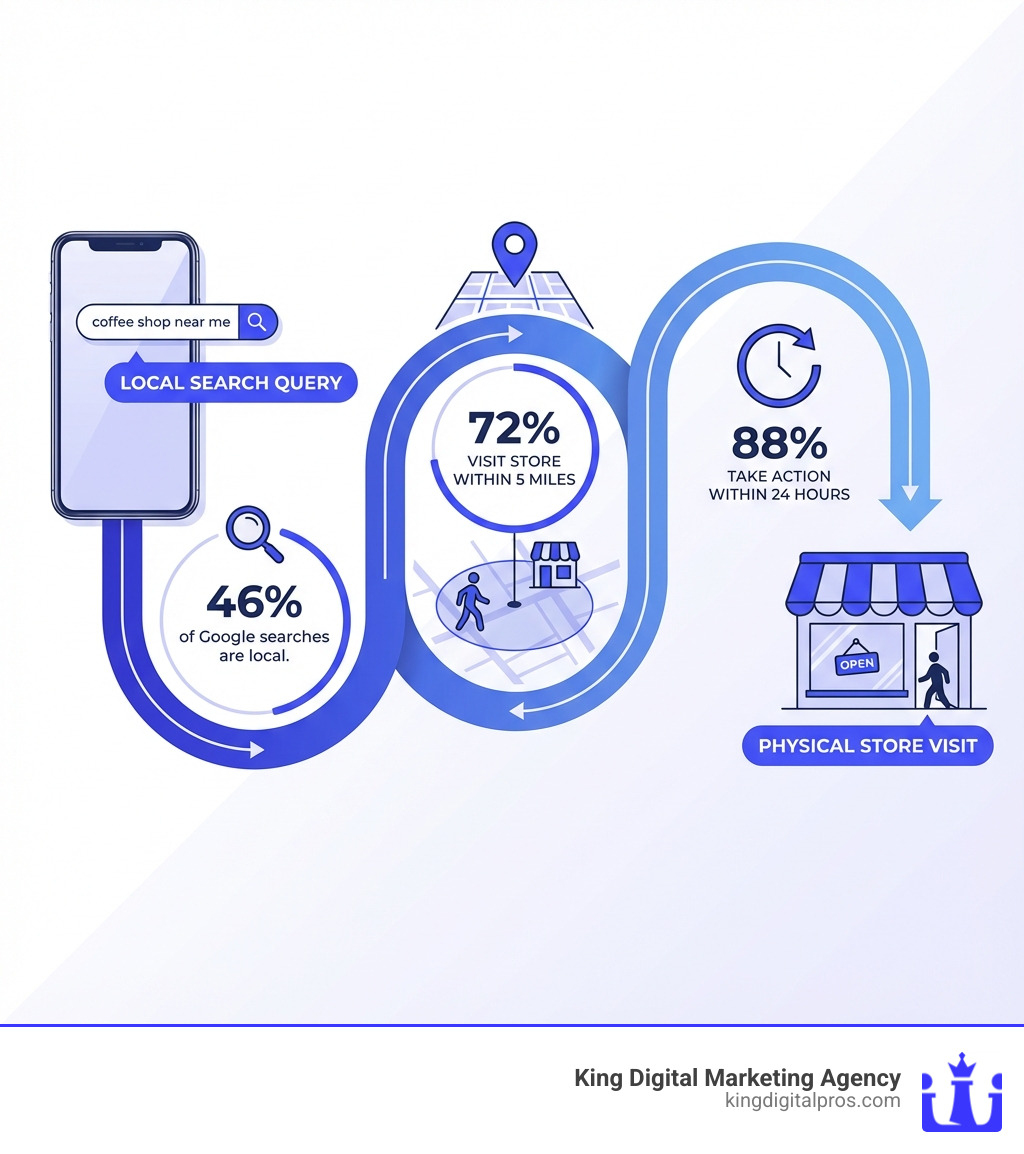
The numbers tell a powerful story. 46% of all Google searches target local information. Even more striking: 88% of people who search for local businesses visit or call within 24 hours. That’s not just traffic – that’s ready-to-buy customers actively looking for what you offer.
But here’s the challenge: most local businesses struggle with confusing map listings, inconsistent information across directories, and Google Business Profiles that sit incomplete and neglected. The difference between ranking first and fifth can mean dozens of missed opportunities every single day.
The good news? Small businesses can compete effectively by focusing their efforts on the local market. You don’t need a massive budget or technical expertise – you need the right strategy executed consistently.
I’m Bernadette King, founder of King Digital Marketing Agency, and I’ve helped dozens of franchise owners and small businesses boost local visibility through targeted SEO and strategic online presence management. Over my career, I’ve learned that local success comes down to mastering a few critical foundations that we’ll cover in this guide.
The Foundation: Mastering Your Google Business Profile
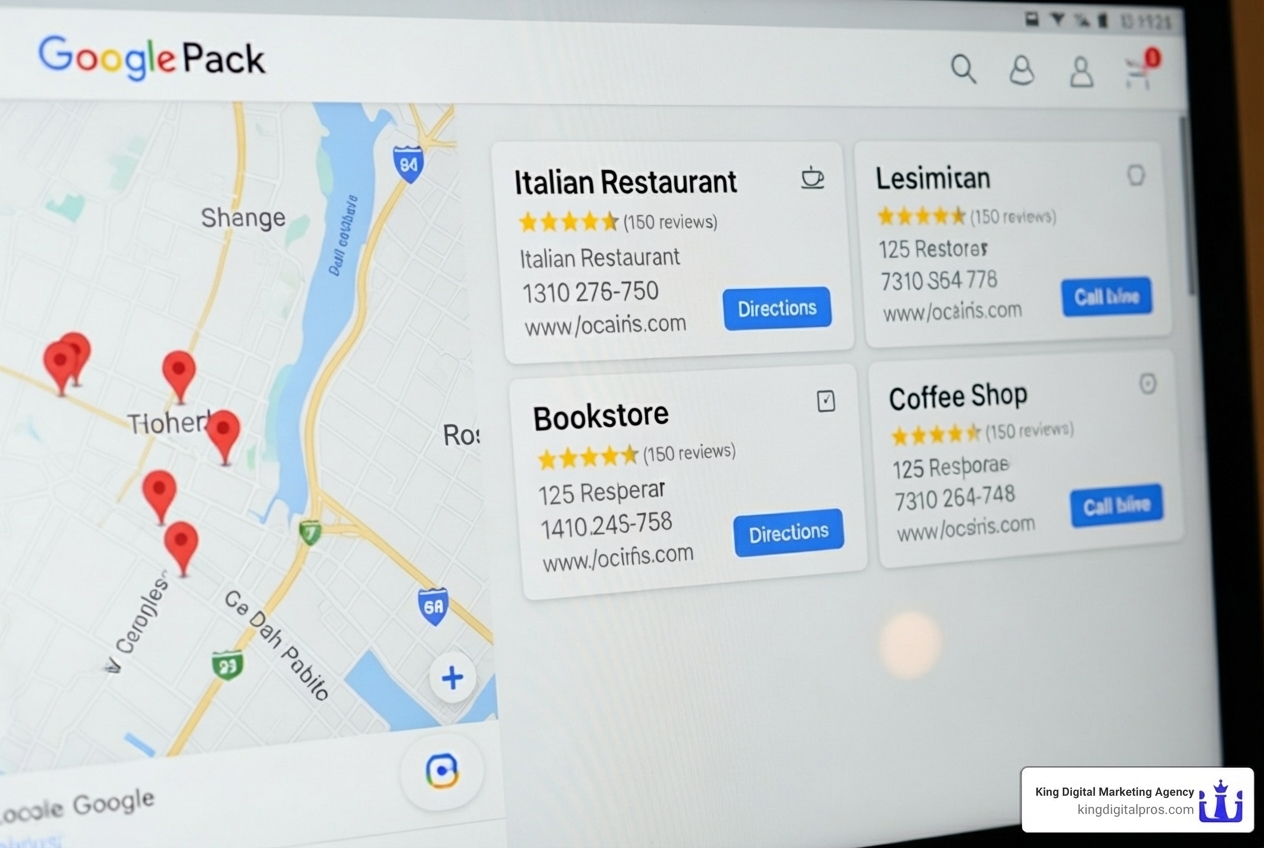
When customers in Albuquerque, Santa Fe, or any of our service areas search for a business like yours, they’ll often find local results on Google Maps and Search. Google’s goal is to connect searchers with the most relevant, helpful businesses nearby. This is where your Google Business Profile (GBP) comes in. It’s your digital storefront, and mastering it is the cornerstone of local SEO success.
Google uses three primary factors to determine local search rankings:
- Relevance: How well your business profile matches what someone is searching for. If someone searches for “best pizza in Rio Rancho,” Google wants to show them pizza places, not plumbing services.
- Distance: How far your business is from the searcher’s location. The closer you are, the better your chances of ranking, especially for “near me” searches.
- Prominence: How well-known your business is. This isn’t just about brand recognition, but also about the information Google can find about your business online, like reviews, articles, and links.
Understanding these factors is key to improving your local ranking. There’s no secret button to push, and Google deliberately keeps its algorithm confidential to ensure fairness. What we can do, however, is optimize every aspect of your GBP to signal maximum relevance, proximity, and prominence. We’ve seen businesses dramatically improve their Google local ranking by focusing on these areas.
For a deeper dive into Google’s own recommendations, check out their Tips to improve your local ranking on Google. And if you ever feel overwhelmed, managing your Google Business Profile is a service we provide to help local businesses like yours thrive. You can always get Google Business Listing Help from our team.
How to Optimize Your Google Business Profile to Boost Local Visibility
Optimizing your GBP is a detailed process, but each step contributes significantly to your ability to boost local visibility.
First things first: Claiming and verifying your profile. If you haven’t already, you need to claim your business profile on Google. Most businesses verify their address by receiving a postcard with a PIN number from Google. Once verified, you have control over your listing. This critical step confirms to Google that you are indeed the rightful owner of the business. Need a hand with this? We offer Google My Business Verification services to ensure this crucial step is done correctly.
Next, focus on ensuring complete and accurate business information. This is where many businesses trip up. Your Name, Address, and Phone number (NAP) must be identical across all online platforms. Inconsistencies confuse search engines and erode customer trust. Beyond NAP, fill out every single field Google provides: hours of operation (including special holiday hours), website URL, a detailed description of your business, and accepted payment methods. 93% of customers hate wrong business information online, and 80% lose trust in businesses with incorrect contact information. Don’t let a typo cost you customers!
Selecting the right business categories is another powerful lever. Google allows you to choose primary and secondary categories. Be as specific as possible. If you’re a “pizza restaurant,” don’t just put “restaurant.” This helps Google understand exactly what you offer, matching you to highly relevant searches.
Don’t forget adding services and products. If you’re a plumber in Grants, list “drain cleaning,” “water heater repair,” and “leak detection” as services. If you sell unique crafts in Taos, showcase those products directly on your profile. This additional detail provides more keywords for Google to match with searches.
Now, for something fun: uploading high-quality photos! This is non-negotiable. Businesses using photos get 42% more driving directions requests and 35% more website clicks. That’s a huge boost! We recommend adding storefront shots, interior photos, product displays, team photos, and even images of your team in action. Use high-quality images (720×720 pixels minimum) and update them weekly. People are visual, and great photos make your business more appealing and trustworthy.
Beyond static information, using Google Posts allows you to share updates, offers, events, and news directly on your profile. Think of it as a mini-blog right on Google Search and Maps. Regularly posting keeps your profile fresh and engaging.
Finally, managing the Q&A section is a fantastic opportunity to address common customer questions and organically include keywords. You can even “seed” this section with frequently asked questions to proactively provide helpful information. Responding to user questions shows you’re engaged and attentive.
Effective Google Profile Management is an ongoing effort, but the rewards are well worth it.
Building Trust and Authority Across the Web
To truly boost local visibility, we need to look beyond just your Google Business Profile. Think of local SEO as having two main components: on-page and off-page.
On-page local SEO refers to all the optimizations you make directly on your website to tell search engines about your business and its location. This includes local keywords, location pages, and technical elements.
Off-page local SEO, on the other hand, involves activities outside your website that influence your local search rankings. This includes your Google Business Profile, local business directories, online reviews, social media mentions, and local backlinks. Both are crucial for building trust and authority. We’ve distilled the best strategies into our Local SEO Best Practices guide.
The Power of Accurate Information and Local Citations
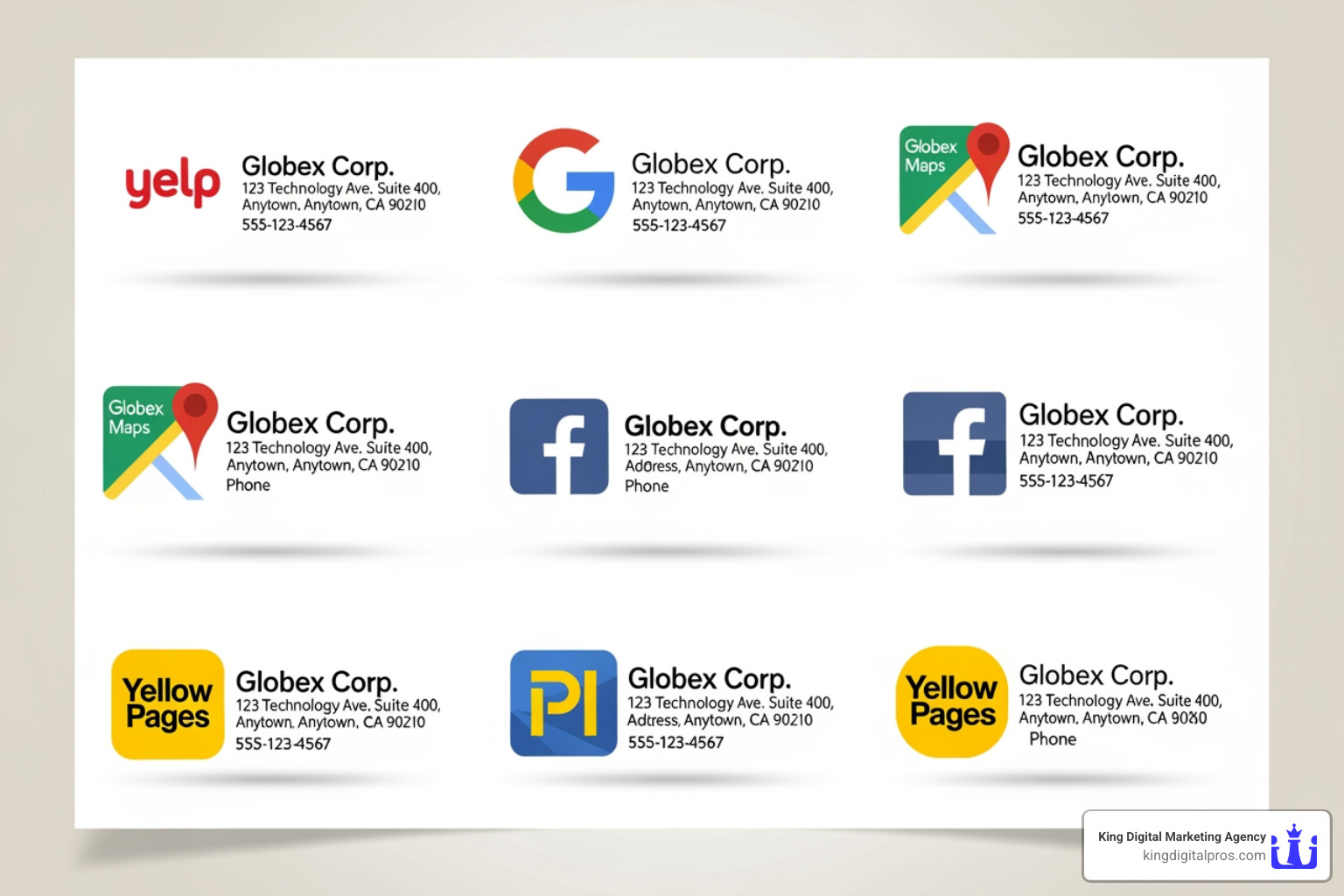
We can’t stress this enough: NAP consistency is paramount. NAP stands for Name, Address, Phone number. Every single instance of your business’s NAP across the internet should be identical. “King Digital Marketing Agency, 123 Main St, Albuquerque, NM 87102, (505) 123-4567” should always be exactly that. Variations like “123 Main Street” or “Ste. 123” instead of “Suite 123” can confuse search engines. When Google sees conflicting information, it doesn’t know which is correct, which can hurt your ranking. This is why 80% of people lose trust in businesses with incorrect contact information, and 73% avoid businesses with wrong listings.
This brings us to utilizing local business directories. These directories, also known as citations, are online mentions of your business’s name, address, and phone number. They act as “votes of confidence” for search engines, verifying your business’s existence and legitimacy. Even though search and social media dominate, local business directories still play a key role in improving online visibility, local SEO, and trust-building. They’re especially important for helping you rank in “near me” searches.
Some of the top directory types to focus on include:
- Google Business Profile: As discussed, this is your primary listing.
- Bing Places for Business: Don’t forget Bing! Many people still use it, and it’s another valuable citation.
- Industry-specific directories: For example, if you’re a plumber, look for plumbing directories. If you’re a restaurant, explore food-related listings.
- Local Chamber of Commerce directories: For businesses in Albuquerque, Santa Fe, or Los Alamos, your local Chamber of Commerce is an excellent resource.
Submitting your business to these reputable directories and ensuring consistent NAP across them all is foundational. It helps search engines cross-reference your information, building your business’s authority. This also directly impacts how easily customers can find you via Attracting Customers Via Google Maps.
Why Customer Reviews are Your Secret Weapon
Imagine you’re looking for a new coffee shop in Cedar Crest. Do you pick the one with no reviews, or the one with 100 five-star ratings? The answer is obvious. Customer reviews and testimonials are incredibly powerful. They function as digital word-of-mouth, influencing both search rankings and customer decisions. Google’s algorithm treats reviews as trust signals, and businesses with consistent, positive reviews tend to rank higher.
Reviews build social proof and credibility. They tell potential customers in Edgewood or Sandia Park that your business is reliable and provides excellent service. The velocity (how frequently you get new reviews) and recency (how recent those reviews are) also matter. Ten reviews this month often outweigh fifty reviews from three years ago.
So, how do we get more of them? We help businesses implement strategies for generating reviews:
- Simply ask! Train your team to politely ask satisfied customers for reviews at the optimal moment – perhaps after a successful service or a pleasant purchase.
- Make it easy: Provide direct links to your Google Business Profile review page.
- Follow up: Send a polite email or text message after a service, asking for feedback and linking directly to review platforms.
Equally important is responding to all reviews, both positive and negative. Acknowledging positive feedback shows appreciation and reinforces good experiences. Professionally responding to negative reviews, on the other hand, demonstrates excellent customer service and a commitment to improvement. It builds trust through transparency, showing potential customers that you care about their experience, even when things go wrong. We’ve seen how a local plumber grew website visits by 50% with customer stories and reviews, proving their immense impact.
How to Boost Local Visibility with On-Page SEO and Content
Your website is your online home, and it needs to be optimized for local search just as much as your Google Business Profile. This includes crucial website optimization essentials like mobile-friendliness, page speed, and local schema markup. Since over 60% of local searches happen on mobile devices, having a fast, responsive, and easy-to-steer mobile website is non-negotiable. If your site loads slowly or is difficult to use on a phone, potential customers in Tijeras will quickly abandon it.
Implementing local schema markup is like speaking Google’s language directly. It’s a special code you add to your website that tells search engines specific details about your business – your name, address, phone number, hours, and even reviews – in a structured format. This helps Google display your information more accurately in search results. For guidance on how to structure your site for optimal performance, our guide on How to Create an SEO Friendly Website Design Structure is a great resource.
Optimizing Your Website with Local Keywords
Just like you wouldn’t open a physical store without knowing your neighborhood, you shouldn’t optimize your website without local keyword research. This involves identifying the specific terms and phrases your target customers in Corrales or Edgewood are using when they search for your products or services.
We focus on using geo-targeted keywords, which are search terms that include a location. Instead of just “massage therapy,” think “massage therapy Albuquerque” or “deep tissue massage Santa Fe.” Don’t forget to optimize for “near me” searches, as these are incredibly common and often indicate high buying intent.
Once you have your local keywords, strategically implement them in your website’s:
- Titles: Your page titles are the first thing searchers see.
- Headers (H1, H2, H3): Use these to structure your content and include keywords naturally.
- Content: Weave keywords naturally into your text, providing valuable information to your readers.
The goal isn’t to stuff keywords but to create content that genuinely answers local search queries. For a comprehensive approach to finding the right terms, our Local SEO Keyword Research guide is invaluable.
Creating Location Pages and Community-Focused Content
For businesses with multiple locations, like a chain operating in Albuquerque, Rio Rancho, and Santa Fe, developing dedicated location pages is essential. Each location should have its own unique page with specific NAP, hours, services, and even testimonials relevant to that particular branch. Don’t just copy and paste content; Google rewards unique, quality content for each page. Our Local SEO Location Pages resource dives deeper into this strategy.
Beyond specific location pages, creating community-focused content is a fantastic way to connect with your local audience and signal relevance to search engines. This could involve:
- Blogging about local events: Cover upcoming festivals in Los Alamos, farmer’s markets in Grants, or community gatherings in Taos.
- Sharing community news and stories: Highlight local achievements, support local charities, or feature local heroes. 57% of customers choose businesses that share community news, so this isn’t just good for SEO, it’s good for community relations!
- Partnering with local organizations: Write about collaborations with other local businesses or non-profits.
This type of content not only engages your local audience but also creates natural opportunities to include local keywords and build authority. For more insights on how Google approaches local search, we recommend exploring Google’s Local Search Documentation.
Creating and Measuring Your Local SEO Marketing Plan
A successful local SEO strategy isn’t just a collection of tactics; it’s a well-thought-out plan with clear goals. Before diving into specific actions, we help businesses in New Mexico with setting clear goals. Do you want more phone calls, foot traffic, online bookings, or leads? Defining your objectives helps us tailor your strategy and measure its effectiveness. Our Local Marketing Strategy Complete Guide offers a comprehensive framework.
It’s also important to understand how local SEO strategies might differ based on your business model. We often categorize businesses as either transactional or informational.
- Transactional businesses (like a restaurant, retail store, or service provider) focus on driving immediate action – a purchase, a booking, or a phone call. Their local SEO will emphasize conversions and direct customer engagement.
- Informational businesses (perhaps a local law firm or medical practice that primarily seeks to educate and build trust before a service is rendered) aim to increase brand awareness and name recognition. Their local SEO might focus more on providing valuable content and establishing expertise.
Regardless of your model, SEO remains a powerhouse. According to HubSpot’s 2025 State of Marketing report, SEO was among the top marketing channels delivering a return on investment (ROI) for business-to-business (B2B) brands in 2024. This highlights the enduring value of optimizing your online presence. Our goal is to help you improve your search ranking and see that ROI.
Leverage Social Media and Local Content to Boost Local Visibility
Social media isn’t just for global brands; it’s a powerful tool to boost local visibility. Platforms like Facebook, Instagram, and even LinkedIn increasingly function as local search engines.
Here’s how we leverage social media for local businesses:
- Geotagging posts: Always tag your physical location in your posts. This connects your content to specific geographical areas and makes it findable by people searching locally.
- Running local awareness ads: Platforms allow you to target users within a specific radius of your business, perfect for promoting specials or events in Albuquerque or Santa Fe.
- Engaging with the local community online: Follow other local businesses, join community groups, and participate in local conversations. Share relevant local news and content.
- Cross-promoting local content: Share your local blog posts, event coverage, and customer stories across your social channels.
Social media allows you to build genuine connections with your local audience, fostering a sense of community around your brand. For more detailed strategies, check out this guide on Sprout Social: Social Media for Local Businesses. If you’re looking for professional help, our Social Media for Businesses services are designed to maximize your local reach.
Measuring Success and Avoiding Common Mistakes
You wouldn’t drive without a dashboard, and you shouldn’t do local SEO without measuring and monitoring the impact of your efforts. Key metrics include:
- Google Business Profile Insights: Google provides valuable data directly within your GBP dashboard, showing how customers are finding your listing (direct search vs. findy search), what actions they’re taking (calls, website clicks, direction requests), and even popular times.
- Tracking website traffic from local sources: Use Google Analytics to see how much traffic is coming from local search queries and specific geographic areas.
- Call tracking: Implementing unique, trackable phone numbers for different marketing channels (like your GBP, website, or local ads) allows you to accurately attribute phone calls to specific efforts.
- Rank tracking: Monitor your position for target local keywords in specific locations.
While local SEO is incredibly effective, there are common mistakes businesses should avoid that can tank your rankings:
- Inconsistent NAP: As we’ve emphasized, conflicting Name, Address, and Phone numbers across online platforms are a major red flag for search engines.
- Keyword stuffing: Overloading your GBP description or website content with keywords in an unnatural way. This hurts readability and can lead to penalties from Google.
- Ignoring reviews: Failing to generate reviews or, worse, not responding to them, makes your business seem disengaged and untrustworthy.
- Neglecting mobile optimization: With so many local searches happening on mobile, a slow, non-responsive website is a huge missed opportunity.
- Using a PO Box or virtual office as your primary address: Google wants legitimate physical locations for local businesses. Service-area businesses should hide their address on GBP and define their service areas instead.
- Changing your business name to include keywords: This violates Google’s guidelines and can lead to penalties or even suspension of your GBP.
Avoiding these pitfalls and consistently applying best practices will set you up for long-term success. If you need expert guidance to steer these complexities, consider partnering with a Digital Marketing Agency for Small Businesses like ours.
Frequently Asked Questions about Boosting Local Visibility
What is local SEO and why is it important for small businesses?
Local SEO is the practice of optimizing your online presence to rank higher in local search results, targeting customers in specific geographic locations like Albuquerque, Rio Rancho, or Santa Fe. It’s crucial for small businesses because it helps them appear in front of ready-to-buy customers who are actively searching for products or services nearby. With 46% of all Google searches targeting local information and 88% of local searchers acting within 24 hours, local SEO directly translates online visibility into foot traffic, phone calls, and sales.
What is the difference between local SEO and regular SEO?
Regular (or traditional) SEO focuses on optimizing your website for broader, national, or even global rankings using general keywords. Local SEO, on the other hand, is specifically custom to a particular geographic area. It emphasizes location-based search queries and factors like proximity, relevance to the search query, and your business’s prominence in a local context. While regular SEO might target “best coffee,” local SEO targets “best coffee shop Albuquerque.” Local SEO also heavily relies on platforms like Google Business Profile and local directories, which are less central to traditional SEO.
How long does it take for local SEO efforts to show results?
Local SEO is a marathon, not a sprint. While some initial improvements (like appearing in the local pack) can be seen within a few weeks of optimizing your Google Business Profile and ensuring NAP consistency, more significant results, such as substantial increases in organic traffic and higher rankings for competitive local keywords, typically take several months. Consistent effort over time, including regular content updates, review generation, and ongoing optimization, is key. Many businesses see a 70% increase in organic traffic within a year with dedicated local content strategies.
What is the single most important factor for local search ranking?
While there isn’t one single factor that outweighs all others, your Google Business Profile (GBP) is arguably the cornerstone of local SEO success. A complete, accurate, and actively managed GBP is essential because it directly influences Google’s three core local ranking factors: relevance, distance, and prominence. Without an optimized GBP, even the best website or most consistent citations won’t get you far in local search results. Close behind are NAP consistency and customer reviews, which heavily contribute to your GBP’s effectiveness and overall prominence.
Conclusion: Become a Local Legend
Mastering your business’s online visibility in your local market – whether you’re in Corrales, Taos, or Grants – is no longer optional; it’s essential for survival and growth. We’ve explored the critical strategies to boost local visibility, from optimizing your Google Business Profile to leveraging customer reviews and creating community-focused content.
The common thread throughout all these efforts is consistency. Consistent NAP information, consistent engagement with customers, and consistent efforts to provide value will build your authority and trust with both search engines and potential customers. Local SEO is a long-term game that rewards dedication.
At King Digital Marketing Agency, we understand the unique challenges and opportunities local businesses face in New Mexico. We’re passionate about turning hidden gems into local legends by simplifying complex digital marketing strategies and implementing them effectively. We’re here to help you get found by the customers who matter most – those right in your neighborhood.
Ready to take control of your online reputation and turn searchers into loyal customers? Explore our expert Review Management Services and let’s start building your local legacy today.