Manage Leads: 5 Stages to Boost Profit
Why Learning to Manage Leads is the Difference Between Thriving and Just Surviving
When you manage leads effectively, you’re not just organizing contact information – you’re building a system that turns interested prospects into loyal, paying customers. Here’s what you need to know:
The Core Elements of Lead Management:
- Lead Capture – Collecting prospect information from multiple sources (website forms, phone calls, social media)
- Lead Tracking – Monitoring how leads interact with your business across all touchpoints
- Lead Qualification – Identifying which prospects are ready to buy and which need more nurturing
- Lead Distribution – Getting the right leads to the right team members at the right time
- Lead Nurturing – Building relationships through targeted follow-up until prospects are ready to purchase
Lead generation is essential, but without a lead management strategy, you’re just catching squirrels with no plan. The numbers tell a stark story: 67% of sales are lost due to improper lead qualification, meaning most businesses leave money on the table because they lack a system to handle the prospects they’ve already attracted.
Lead management is the critical bridge between marketing and sales. As defined by industry experts, it encompasses all the processes – from attraction and qualification to conversion – that turn prospects into a predictable revenue pipeline. For local business owners, this is even more critical. You’re competing for visibility on Google Maps and managing online reviews while running day-to-day operations. Every lead represents real money, and without a system, potential revenue walks out the door.
I’m Bernadette King, founder of King Digital Marketing Agency, and I’ve spent years helping local businesses transform their lead management from chaotic spreadsheets into systematic revenue engines. I’ve learned that the ability to effectively manage leads is what separates businesses that scale from those that struggle.
The value extends to retention: acquiring new customers costs 5 times more than keeping existing ones. A mere 5% increase in customer retention can boost profits by 25-95%. This proves that lead management isn’t just about the first sale; it’s an ongoing process that builds long-term business value.
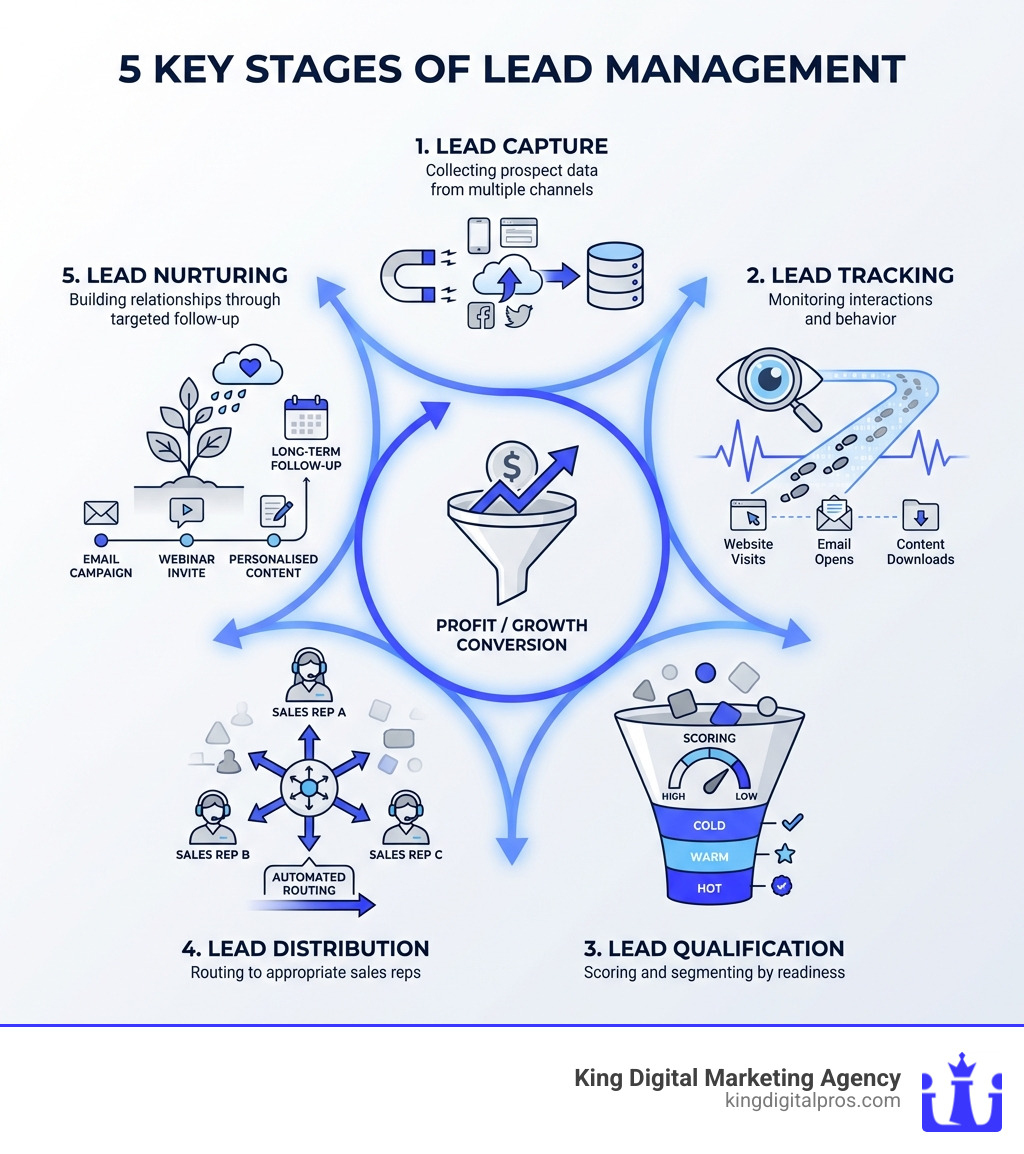
The 5 Stages of the Lead Management Lifecycle
Imagine lead management as a well-oiled machine, designed to take a raw inquiry and turn it into a satisfied customer. This machine operates in distinct, yet interconnected, stages. Understanding each stage is crucial to effectively manage leads and maximize your conversion rates.
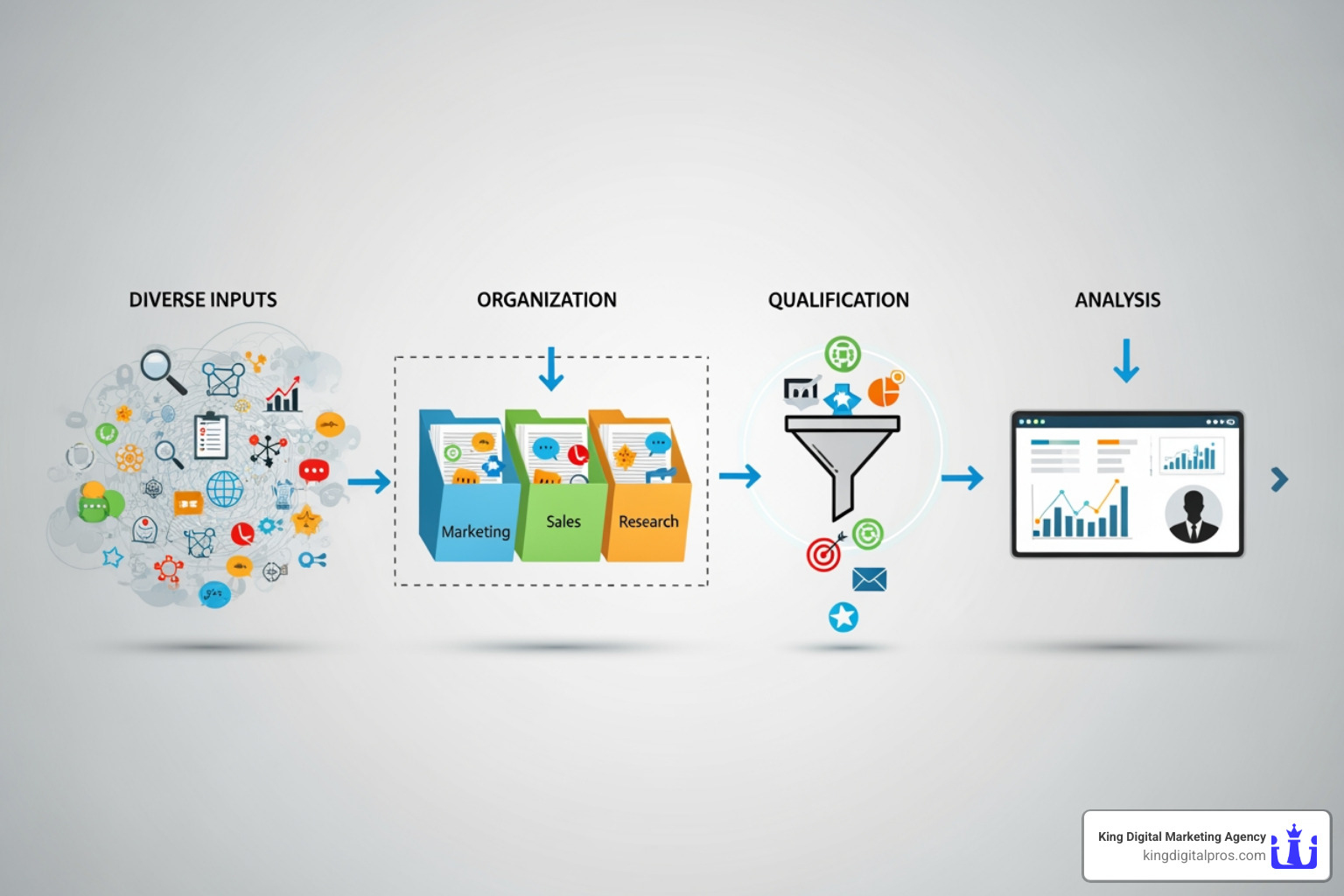
Stage 1 & 2: Lead Capture and Tracking
Lead capture is the first step: gathering information from potential customers. For local businesses in Albuquerque or Santa Fe, leads can come from Google Business Profile calls, website forms, social media messages, or walk-ins. All this information must be centralized, not left on scattered notes. A Customer Relationship Management (CRM) system is indispensable here, acting as a central hub for all lead data, including their source. This is fundamental to collecting leads effectively.
Next is lead tracking: monitoring every interaction a lead has with your business. Did they visit your pricing page or open an email? This behavioral and engagement data reveals their interest level. For example, a lead from Grants, NM, repeatedly viewing your HVAC repair page is likely a hot prospect. This tracking allows for a custom, timely approach. Well-managed CRM Leads give your whole team streamlined access to this crucial information.
Stage 3: Lead Qualification and Segmentation
Not all leads are created equal. Lead qualification is the process of identifying which prospects are most likely to buy, allowing you to prioritize your time and resources. Since improper qualification is a major source of lost sales, this stage is critical.
We categorize leads in several ways:
- By Temperature:
- Hot Leads: Ready to buy now; may have requested a quote.
- Warm Leads: Strong interest but still researching; engaging with content.
- Cold Leads: Initial interest but require significant nurturing.
- By Qualification:
- Information Qualified Leads (IQLs): Consumed content but show low buying intent.
- Marketing Qualified Leads (MQLs): Engaged with marketing (e.g., downloaded an ebook) and fit demographic criteria.
- Product Qualified Leads (PQLs): Used a product trial/freemium version and show interest in upgrading.
- Sales Qualified Leads (SQLs): Vetted by sales/marketing and ready for direct sales engagement; fit ideal customer profile with a clear need and budget.
Segmentation groups leads by shared traits like location (e.g., landscaping leads in Cedar Crest, NM), industry, or specific needs for targeted messaging. This is also when you disqualify unfit leads to avoid wasting everyone’s time.
Stage 4 & 5: Lead Distribution and Nurturing
Lead distribution is about assigning qualified leads to the right sales rep. Routing can be based on territory (a lead from Edgewood goes to the local rep), service interest, or rep availability. A CRM can automate this process to ensure leads are handled swiftly and fairly.
The final, most crucial stage is lead nurturing, which builds relationships with prospects who aren’t ready to buy immediately. It involves guiding them with valuable, relevant communication – via email, targeted content, or personal calls – until they are ready to purchase. Since the sales cycle from first contact to becoming a paying customer varies, nurturing keeps your business top-of-mind and builds authority. This process continues post-sale to foster loyalty and encourage repeat business.
Best Practices to Effectively Manage Leads
Having a clear understanding of the lead management lifecycle is a great start, but successful execution requires adopting specific best practices. These are proven strategies that lead to tangible results for businesses like yours across Los Alamos, Taos, and beyond.

Aligning sales and marketing is critical; 85% of leaders agree it’s the biggest opportunity for improving business performance. When both teams are on the same page regarding strategy, customer data, and content, the entire lead management process becomes seamless.
Data quality is another cornerstone. Poor data quality can cost companies a quarter or more of their revenue, according to one survey. Ensure your lead data is accurate and consistent through regular cleanups and clear data entry standards.
Other key practices include timely follow-up (speed matters when a lead from Tijeras, NM, shows interest), personalization (nearly 80% of leaders say consumers spend more with a personalized experience), and a focus on customer retention, which is often more profitable than acquisition.
How to manage leads with scoring and grading
To effectively manage leads, especially at high volume, we use lead scoring and grading – two complementary methods for prioritizing efforts.
Lead Scoring assigns points to a lead based on their activities. For example:
- Visiting your pricing page: +10 points
- Downloading a case study: +5 points
- Opening an email: +1 point
The higher the score, the more engaged the lead is. Inbound Lead Scoring helps identify leads showing active buying signals.
Lead Grading assesses how well a lead fits your ideal customer profile based on attributes like:
- Location (e.g., within our service area of Albuquerque, NM): A+
- Industry (e.g., local small business): A+
- Company size (e.g., 1-10 employees): A
Combining scoring and grading provides a comprehensive view. A high-score, low-grade lead might be curious but unlikely to convert. A high-grade, low-score lead is a perfect fit who needs more nurturing. This dual approach ensures sales teams focus on the most promising prospects. Many businesses use Lead Scoring Services to optimize these systems.
The Power of Personalization and Retention
Generic messages don’t work in today’s competitive landscape. Personalization is key, as 47% of buyers say that they are more likely to buy from a seller who is aware of their needs. This means understanding their pain points and challenges, which we gather through careful lead tracking and observation.
Efforts shouldn’t stop once a lead becomes a customer. As mentioned, retaining customers is more cost-effective than acquiring new ones. Continuing to build these relationships opens up potential for upselling and cross-selling. For example, a client in Sandia Park, NM, who bought a basic SEO package might later be interested in advanced local listing management.
The impact of retention on profitability is significant. Loyal customers are also more likely to refer new business, becoming invaluable advocates for your brand. This reinforces that effective lead management is a continuous cycle that extends far beyond the initial sale, fostering long-term growth.
Leveraging Technology and Automation for Efficiency
Trying to manage leads manually is like trying to catch squirrels with a teacup – inefficient and prone to error. Technology and automation transform your lead management process from a chaotic chore into a streamlined, productive engine.
Technology’s role is to centralize data, automate tasks, provide insights, and ensure consistency. The benefits are clear: better organization, faster responses, improved qualification, and higher conversion rates. Automation, specifically, allows you to scale your efforts efficiently, ensuring no lead is neglected.
Key technologies to manage leads efficiently
At the heart of modern lead management are Customer Relationship Management (CRM) systems and marketing automation platforms.
CRM systems help you organize, track, and manage all customer interactions. They provide a centralized database for lead information and communication history, ensuring your team has everything they need to know about a lead from Edgewood, NM.
Marketing automation platforms automate repetitive tasks like email campaigns and lead nurturing workflows, triggering actions based on lead behavior for timely communication.
Many businesses use dedicated Lead Manager Software that combines these functionalities. When evaluating software, look for core features like:
- Visualizing leads in pipelines: Drag-and-drop interfaces showing where each lead is in the sales process.
- Automated email sequences: Sending personalized follow-ups without manual intervention.
- Lead enrichment: Automatically pulling in additional data about a lead from public sources.
- Source tracking: Knowing exactly where each lead came from.
- Follow-up reminders: Ensuring no lead is forgotten.
- Email and website tracking: Monitoring engagement with your digital content.
- Live notification center: Real-time alerts for lead activity.
- Business card scanner: Quickly adding new contacts from networking events.
- Email templates: Standardizing communications for efficiency.
- Inbox sidebar management: Integrating lead data directly into your email client.
Data sync tools are also crucial for ensuring information is consistent across all your applications, keeping your databases clean and reliable.
How to Choose the Right Lead Management System
Selecting the right lead management system is a critical decision. It’s not a one-size-fits-all solution, especially for local businesses. Here’s what we consider:
- Scalability: Will the system grow with your business? As your client base in Corrales expands, the software should handle the increased volume and complexity.
- User-friendliness: If the software is too complex, your team won’t use it, rendering it useless. An intuitive interface and easy setup are paramount for adoption.
- Integration capabilities: Your lead management system should seamlessly integrate with your website, email platform, and other daily tools to prevent data silos.
- Cost vs. ROI: Weigh the cost against the potential return on investment from efficiency gains, increased conversions, and improved retention. Free options often lack features needed for serious growth.
- Industry fit: Some systems are better for B2B, others for B2C. We look for a system that understands our local market, such as one that effectively tracks leads from a Google Business Profile.
While an Excel sheet can be a starting point, it lacks the automation needed to truly optimize lead management. Investing in the right system is an investment in your business’s future.
Measuring Success: Key KPIs for Lead Management
How do we know if our lead management efforts are actually paying off? By tracking key performance indicators (KPIs). Without measurement, we’re just guessing. Tracking these metrics allows us to identify what’s working, what’s not, and where we need to adjust our strategy to improve results. This is the essence of Lead Conversion Tracking.
Here are the essential KPIs we monitor:
-
Lead-to-Sale Conversion Rate: This is perhaps the most critical metric. It tells us the percentage of leads that ultimately become paying customers. For example, if you generate 100 leads and 10 convert, your conversion rate is 10%. Conversion rates can vary significantly by industry and business model. In the B2C segment, the lead-to-sale conversion rate ranges between 1.8% and 19%, depending on your target market. For B2B, it can vary from 0.35% to 40%. Knowing your average helps us set realistic goals and identify areas for improvement.
-
Sales Cycle Length: This measures the average time it takes for a lead to move from initial contact to becoming a paying customer. A long sales cycle might indicate bottlenecks in your nurturing process or qualification. By shortening the sales cycle, we can accelerate revenue growth.
-
Cost Per Lead (CPL): This calculates how much it costs you to acquire a single lead. We divide our total marketing and sales expenses by the number of leads generated. A lower CPL means more efficient lead generation.
-
Lead Value: This metric helps us understand the average revenue generated by a lead. By calculating the average customer lifetime value and factoring in your conversion rate, you can determine the monetary worth of each lead. This is crucial for making informed decisions about marketing spend and sales effort. If you need help figuring this out, our guide on How to Calculate Lead Value can walk you through the process.
By regularly monitoring these KPIs, we gain actionable insights into the health of our lead management system. We can pinpoint which lead sources are most effective, which nurturing strategies yield the best results, and where our sales team can improve their conversion efforts. This data-driven approach is what allows us to continuously optimize and drive consistent growth for local businesses across New Mexico.
Frequently Asked Questions about Lead Management
We often encounter common questions about lead management, especially from business owners eager to optimize their sales process. Let’s address some of the most frequent ones.
What is the difference between lead management and pipeline management?
While related, these terms have distinct focuses:
-
Lead management focuses on the initial stages: capturing, tracking, qualifying, and nurturing potential clients before they are ready for a direct sales push. It’s about developing raw interest into a viable prospect.
-
Pipeline management refers to managing the entire customer journey through the sales process, from the point a qualified lead enters the sales pipeline all the way to closing the deal. It involves tracking prospects at each phase of the sale.
In short, effective lead management feeds your sales pipeline with qualified prospects, making pipeline management more efficient.
What are the most common types of leads?
As we covered in the Lead Qualification stage, leads are typically categorized in two main ways:
- By Temperature: This describes their readiness to buy, ranging from Hot (ready now) to Warm (interested but researching) to Cold (low interest, needs nurturing).
- By Qualification: This describes their stage in the marketing and sales funnel. The main types are Marketing Qualified Leads (MQLs), who have engaged with marketing materials, and Sales Qualified Leads (SQLs), who have been vetted and are ready for a direct sales conversation.
Understanding these distinctions is key to tailoring your communication and prioritizing your team’s efforts.
How quickly should I respond to a new lead?
Speed is critical. Research consistently shows that faster response times lead to higher conversion rates. A 24-hour response is often too slow.
Many experts advocate for the “5-minute rule”: try to contact a new lead within five minutes of their inquiry. The impact on conversion is dramatic, as leads contacted this quickly are far more likely to be qualified. The longer you wait, the colder the lead becomes, and the more likely they are to have moved on to a competitor.
For local businesses, this means having systems for immediate notifications when a new lead comes in. Automation tools can send instant alerts or even initiate the first contact via email or text. This rapid response demonstrates attentiveness and sets a positive tone for the relationship.
Conclusion: Turn Your Leads into Lasting Revenue
We’ve covered a lot of ground today, from understanding the core stages of the lead management lifecycle to implementing best practices, leveraging technology, and measuring success. The journey from prospect to profit is not a straight line, but with a systematic approach to manage leads, it becomes a predictable and repeatable process.
Effective lead management is the backbone of your sales process. It’s about bridging the gap between your marketing efforts and your sales results, ensuring that every interested prospect receives the attention and nurturing they need. By prioritizing lead capture, tracking, qualification, distribution, and nurturing, you’re building a robust foundation for sustainable business growth.
The future of lead management will continue to be shaped by advancements in AI and personalization, making it even easier to understand and engage with your prospects on a deeper level. But the fundamental principles remain the same: understand your leads, provide value, and build relationships.
At King Digital Marketing Agency, we understand the unique challenges and opportunities for local businesses in New Mexico. We’re passionate about helping businesses in Albuquerque, Rio Rancho, Santa Fe, and surrounding communities not just generate leads, but effectively manage them to drive lasting revenue. Our Lead Tracking Services are designed to give you the clarity and control you need to turn every prospect into a loyal customer.
Don’t let your valuable leads turn into lost opportunities. Implement these strategies, accept the right tools, and watch your business thrive.
