What is geofencing in digital marketing: 2026 Winning
Why Location-Based Marketing Matters More Than Ever
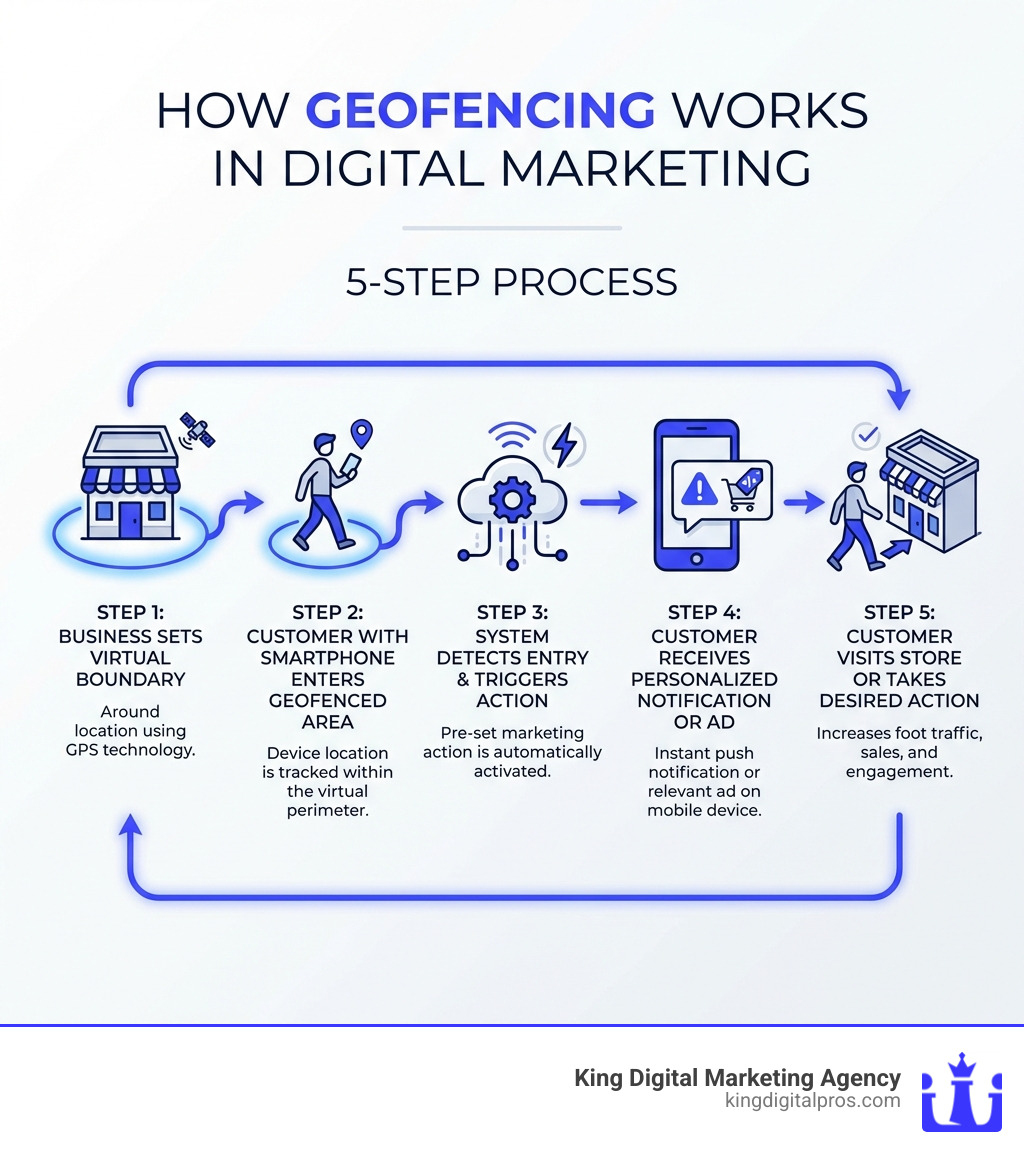
What is geofencing in digital marketing is a location-based marketing strategy that creates virtual boundaries around specific geographic areas. When customers with mobile devices enter these boundaries, they automatically receive targeted ads, push notifications, or special offers on their smartphones.
Key components of geofencing:
- Virtual Perimeter – A digital fence drawn around a physical location (your store, a competitor, or an event)
- Location Technology – Uses GPS, Wi-Fi, cellular data, or Bluetooth to detect when someone enters the zone
- Triggered Actions – Automatically sends personalized messages, ads, or notifications to nearby customers
- User Consent – Requires customers to opt-in and grant location permissions through mobile apps
The numbers tell a compelling story. “Open now near me” searches have increased by 400% in the last year, and the mobile commerce industry is tipped to exceed $2.5 trillion in retail sales this year. For local businesses, this means unprecedented opportunity to reach customers exactly when and where they’re ready to buy.
Why it works:
71% of consumers prefer personalized ads, and 53% of shoppers visited a specific retailer after receiving a location-based alert. More importantly, over half of those visits were unplanned, meaning the notification prompted an unexpected visit.
I’m Bernadette King, founder of King Digital Marketing Agency, and I’ve helped dozens of local businesses transform their customer acquisition using what is geofencing in digital marketing strategies that drive real foot traffic and measurable ROI. The technology has evolved from a complex enterprise tool to an accessible, results-driven tactic that even small businesses can leverage effectively.
Easy what is geofencing in digital marketing glossary:
What is Geofencing in Digital Marketing and How Does It Work?
At its heart, what is geofencing in digital marketing is about creating a virtual fence around a real-world location. Imagine drawing an invisible boundary around your storefront in Albuquerque, a specific event in Santa Fe, or even a competitor’s business in Rio Rancho. When a potential customer’s mobile device crosses this digital line, it triggers a pre-programmed action, like sending them a special offer or an advertisement. It’s like having a digital greeter for your business, always ready to deliver the right message at the perfect moment.
This technology isn’t new, but its value has skyrocketed with the widespread adoption of smartphones. With over 90% of Americans owning a smartphone, our devices are constantly sending out location information, making geofencing a powerful tool for businesses to connect with their audience. This precision targeting is why the global market size of geofence tools is already substantial and is expected to grow 21.7% by 2030.
The Core Technology: GPS, Wi-Fi, and Guides
So, how do we draw these magical virtual fences and know when someone crosses them? Geofencing relies on several key technologies working in harmony:
- GPS (Global Positioning System): This is the backbone of most geofencing efforts. GPS uses a network of satellites orbiting Earth to triangulate a device’s precise location. This allows us to define boundaries with remarkable accuracy, whether it’s a small boutique in Corrales or a large event venue in Grants. For businesses managing fleets, GPS tracking combined with geofencing can alert managers if a vehicle enters or leaves a designated area, enhancing efficiency and security.
- Wi-Fi Networks: Wi-Fi signals can also be used to determine location, especially in urban areas or inside buildings where GPS signals might be weak. By identifying known Wi-Fi networks, a device’s location can be pinpointed with impressive accuracy.
- Cellular Data: Our mobile phones are constantly communicating with cell towers. This cellular data can provide a broader, less precise location, but it’s still crucial for detecting general movement into or out of larger geofenced areas.
- Bluetooth Guides (Guides): For hyper-local accuracy, especially inside stores or specific sections of a business, Bluetooth guides come into play. These small, low-energy devices emit radio waves that mobile devices can detect. When a user’s phone comes within range of a guide, it can trigger highly specific actions, like sending a discount for a product aisle they’re standing in. Think of it as a super-precise, mini-geofence within a larger one.
- RFID (Radio-Frequency Identification): While less common for consumer marketing, RFID tags can be used in specialized geofencing applications, such as tracking assets or inventory within a defined physical space.
The Crucial Role of Mobile Apps and User Opt-In
For geofencing to work its magic, mobile apps play a pivotal role. Most geofencing marketing actions, such as push notifications or in-app messages, are triggered through an application installed on the user’s smartphone. This isn’t just limited to your own branded app; it can also happen through third-party apps, social media platforms, or even mobile web browsers that have ads enabled.
However, there’s a critical component: user opt-in. We live in an age where data privacy is paramount, and rightly so. For geofencing to function, users must explicitly grant permission for location services on their devices. This means that transparency is key. Users need to understand why their location data is being used and what benefits they’ll receive in return.
Reputable geofencing platforms and apps prioritize user consent and make privacy settings clear. Developers looking to implement geofencing in their own custom apps can find extensive documentation from companies like Microsoft and Google on how to integrate these features while respecting user privacy. This ensures that when we deliver a timely offer for a delicious green chile burrito to someone near your Taos restaurant, it’s because they’ve chosen to receive such valuable, location-aware messages.
Geofencing vs. Geotargeting: Understanding the Key Differences
These two terms often get confused, but understanding their distinct approaches is crucial for crafting an effective location-based marketing strategy for your business in Santa Fe or Edgewood. While both leverage location, they operate at different levels of precision and intent.
| Feature | Geofencing | Geotargeting |
|---|---|---|
| Precision | Highly precise, virtual perimeter (e.g., a store, a city block) | Broader geographic area (e.g., zip code, city, state) |
| Trigger | Real-time entry, exit, or dwell within a defined boundary | User’s general location or IP address |
| Timing | Real-time, immediate action | Can be real-time, but often based on broader location data |
| Technology | GPS, Wi-Fi, cellular data, Bluetooth guides | IP addresses, GPS (for broader areas) |
| Objective | Drive immediate action, foot traffic, in-the-moment engagement | Deliver relevant ads to a general area, online purchases, brand awareness |
| Data Collection | Can track foot traffic, dwell time, entry/exit patterns | Typically less granular, focuses on audience demographics within an area |
| Typical Use Case | Sending a coupon when a customer walks past your Los Alamos store | Displaying ads for all businesses in a specific zip code |
Geofencing is like a sniper rifle – precise, targeted, and designed for immediate impact. It’s perfect for delivering a flash sale notification to someone walking past your Grants retail store. Geotargeting, on the other hand, is more like a billboard – it reaches a broader audience within a larger area, useful for general awareness campaigns across all of Albuquerque. We often find that combining both strategies offers the most comprehensive approach, allowing us to capture both immediate intent and broader market reach.
The Key Benefits and Real-World Use Cases of Geofencing
Geofencing isn’t just a fancy buzzword; it’s a powerful tool that can genuinely transform how businesses in New Mexico connect with their customers. From hyper-personalization to driving tangible results, the advantages are clear. If you’re looking to grow your local business, our Small Business Geofencing Guide offers even more insights.
Top Benefits for Your Business
For businesses in areas like Sandia Park and Tijeras, geofencing offers several compelling benefits:
- Hyper-Personalization: Imagine sending a customer a discount for their favorite coffee just as they approach your cafe. This level of personalization makes customers feel seen and valued. As the statistics show, 71% of consumers prefer a personalized ad. We’re not just sending ads; we’re creating relevant, timely experiences.
- Increased Engagement: By delivering messages exactly when they’re most relevant, geofencing cuts through the noise. A notification about a lunch special as someone leaves a nearby office building is far more engaging than a generic ad at home.
- Improved Customer Experience: We’re helping customers find what they need, right when they need it. This convenience and relevance improve their overall experience with your brand.
- Better Ad Spend Efficiency: Instead of broad, untargeted advertising, geofencing focuses your marketing dollars on potential customers who are physically near your business or a relevant location. This means less wasted ad spend and a higher likelihood of conversion.
- Increased Foot Traffic: This is often the holy grail for local businesses. Geofencing can directly drive people through your doors. A remarkable 53% of shoppers visited a retailer after receiving a location-based alert, with over half of those visits being unplanned. That’s the power of an impulse visit, driven by a timely offer.
- Valuable Customer Insights: Geofencing platforms can track how many people entered your geofence, how long they stayed, and even if they converted into a sale. This data provides invaluable insights into customer behavior, allowing us to refine and optimize future campaigns.
- Competitive Advantage: By strategically placing geofences around competitor locations, we can “conquest” their customers with superior offers, encouraging them to try your business instead. It’s a bold move, but it works!
Inspiring Geofencing Examples Across Industries
Geofencing isn’t limited to a single industry; its versatility makes it applicable to a wide range of businesses. We’ve seen incredible results across various sectors, often by thinking creatively about where and when to engage potential customers.
- Retail: Imagine a clothing store in Santa Fe setting a geofence around its location. As shoppers enter the fence, they receive a push notification for a 15% discount on new arrivals. This drives immediate foot traffic and impulse purchases.
- Restaurants & Hospitality: A coffee shop in Corrales could geofence nearby office buildings, sending out lunch specials during midday hours. Or, a hotel in Taos could use geofencing to offer last-minute room discounts to travelers within a few miles of their location after 3 PM, filling empty rooms.
- Healthcare: A regional senior care center, for instance, successfully used geofencing ads to target emergency rooms, hospitals, and even competing care facilities. This strategic approach resulted in 60 walk-ins and tours over just a 30-day period. This demonstrates geofencing’s power in attracting specific demographics at critical moments.
- Fitness Centers: A gym in Rio Rancho looking to boost memberships could geofence competing fitness centers in the area. When potential members are at a rival gym, they receive an ad for a free trial or a special sign-up offer at your facility. One gym gained 73 new extended memberships, generating about $38,000 in revenue, using this exact tactic.
- Staffing & Recruitment: Geofencing isn’t just for customers. A hotel used geofencing marketing to increase staff by targeting other hotels in the area and promoting open housekeeping positions. This resulted in 60 applications and a 20% capacity increase, proving its utility in niche recruitment.
These examples highlight how geofencing can be custom to very specific business goals, whether it’s driving sales, increasing awareness, or even recruiting talent.
How to Create and Implement a Winning Geofencing Strategy
Implementing a successful geofencing campaign isn’t just about drawing a circle on a map; it requires a thoughtful, strategic approach. We follow a clear process to ensure your campaigns are effective and deliver measurable results. For a deeper dive, check out our Geofencing Marketing Complete Guide.
Step 1: Define Your Goals and Target Audience
Before we even think about virtual fences, we need to understand what you want to achieve and who you want to reach.
- Set SMART Goals: Do you want to increase walk-ins to your Albuquerque boutique by 20% next quarter? Boost sales of a specific product line in your Los Alamos store? Or simply increase local brand awareness in Cedar Crest? Clear, specific, measurable, achievable, relevant, and time-bound (SMART) goals are our starting point.
- Understand Your Audience: Who are your ideal customers? What are their demographics, behaviors, and pain points? Are we targeting tourists in Santa Fe, students in Edgewood, or busy professionals in Rio Rancho? Creating detailed buyer personas helps us craft messages that truly resonate. We also consider mobile user behavior-when are they most likely to be on their phones, and what kind of messages would they be receptive to?
Step 2: Choose Your Locations and Set Up the Geofence
This is where the “geofence” truly comes to life. The strategic selection of locations is paramount.
- Your Business Perimeter: The most obvious, yet highly effective, choice is to draw a geofence around your own storefront. This allows us to engage customers who are already nearby and ready to make a purchase.
- Competitor Locations: As we saw in the examples, placing geofences around rival businesses can be a powerful tactic to “conquest” their customers with a better offer.
- Event Venues & Community Hotspots: Think about local events, festivals, parks, or popular public spaces in Grants or Tijeras. Geofencing these areas allows us to capture large, relevant audiences.
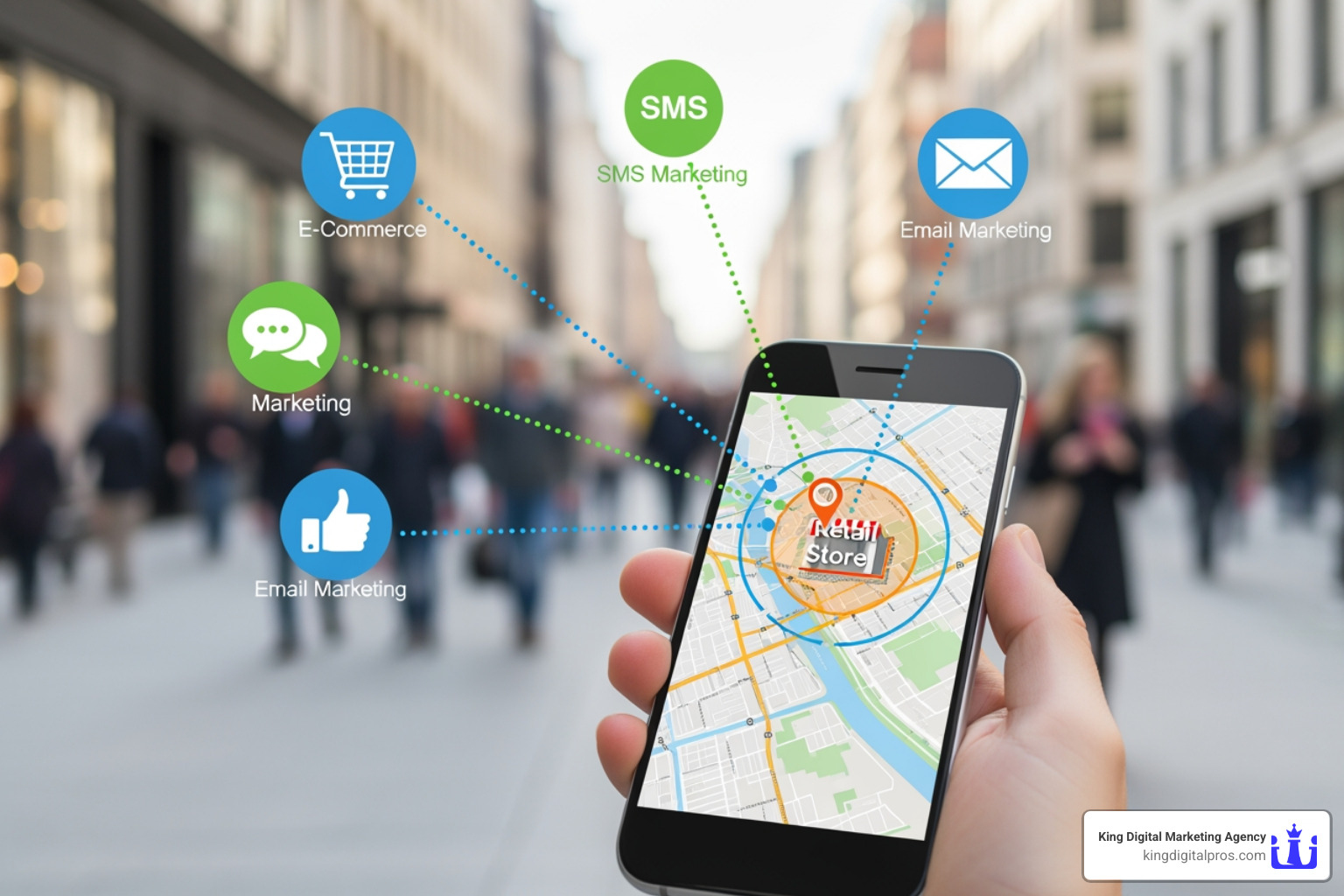
- Radius vs. Polygon Fences: While a simple circular radius is common, we often use more precise “polygon fences” to accurately outline specific buildings, shopping malls, or even specific floors within a complex. This level of detail ensures we’re targeting the right people in the right place. Our Best Geofencing Marketing Software Guide can help you explore the tools that enable this precision.
- Size Matters: We carefully consider the size of the geofence. Too large, and your message might feel irrelevant. Too small, and you might miss potential customers. For urban areas like Albuquerque, a 4-5 minute walking radius might be ideal, while in more rural settings like the East Mountains, a mile or two could be appropriate.
Step 3: Craft Compelling, Action-Oriented Messages
A perfectly placed geofence is only as good as the message it delivers. This is where creativity meets strategy.
- Personalized Offers: Generic messages are easily ignored. We leverage any available customer data (with consent, of course!) to make offers feel tailor-made. “Hi [Customer Name], your favorite green chile latte is 20% off today!”
- Time-Sensitive Deals: Urgency drives action. “Flash sale: 30% off all decor for the next 2 hours!” encourages immediate foot traffic.
- Clear Call-to-Action (CTA): What do you want them to do? “Visit us now for your discount,” “Tap here to claim your coupon,” or “Call us to book an appointment” are direct and effective.
- Relevant Content: If someone is near a car dealership in Rio Rancho, an ad for a test drive makes sense. If they’re near a restaurant, a lunch special is appropriate. Context is king.
- Mobile-First Design: These messages are landing on small screens. They need to be concise, visually appealing, and load quickly.
Step 4: Measure Your Campaign’s Success and ROI
The beauty of digital marketing, especially with geofencing, is the ability to track and measure almost everything. We don’t just launch campaigns and hope for the best; we carefully monitor their performance to ensure we’re achieving your goals.
- Click-Through Rate (CTR): This tells us how many people who saw your ad or notification actually clicked on it. A good CTR indicates that our messaging is resonating.
- Conversion Rate: The ultimate metric! This measures how many people who clicked actually completed the desired action – whether it’s walking into your store, making a purchase, or signing up for a newsletter.
- Foot Traffic Lift: Many geofencing platforms can track the increase in physical store visits directly attributable to your campaign. This is invaluable for local businesses.
- Cost Per Acquisition (CPA): How much does it cost us to acquire a new customer or achieve a specific conversion through geofencing? This helps us optimize our budget.
- Return On Ad Spend (ROAS): This metric tells us how much revenue is generated for every dollar spent on the geofencing campaign. It’s a clear indicator of profitability. Our Geofencing Advertising Cost guide provides more details on budgeting for these campaigns.
- A/B Testing: We continuously test different messages, offers, geofence sizes, and triggers to find what performs best. This iterative process ensures continuous improvement and maximum ROI.
Step 5: Address Challenges and Adhere to Best Practices
While incredibly powerful, geofencing isn’t without its considerations. We proactively address these to ensure smooth and ethical campaign execution.
- Privacy Concerns and User Consent: As we discussed, user consent is non-negotiable. 62% of Americans worry about data privacy, and we respect that. We ensure transparent communication about data usage and provide clear opt-out options. We also stay informed about evolving privacy regulations, like geofencing laws by state, to ensure compliance in New Mexico.
- Accuracy Issues: While generally precise, GPS and location data can sometimes be less accurate in areas with poor cellular connectivity or dense urban environments. We account for this in our geofence design and targeting.
- Battery Drain: Constant location tracking can consume battery life. We optimize our campaigns to minimize this impact, ensuring a positive user experience.
- Message Frequency: Nobody likes spam. We carefully manage the frequency of notifications to avoid overwhelming users, striking a balance between engagement and annoyance.
- Staff Readiness: If your geofencing campaign offers in-store discounts, ensure your team in the Albuquerque or Santa Fe location is fully aware and ready to honor them seamlessly.
By adhering to these best practices, we can harness the immense power of geofencing responsibly and effectively for your business.
Frequently Asked Questions about Geofencing
We often get asked a few common questions about geofencing. Let’s clear them up!
Can you use geofencing without an app?
Yes, absolutely! While many geofencing campaigns leverage proprietary mobile apps for push notifications, it’s not the only way. Potential customers don’t necessarily need your specific app to receive geofenced ads. Here’s how:
- Third-Party Apps: Many popular apps, from social media platforms to news and weather apps, integrate location-based advertising. If a user has location services enabled for these apps, they can receive geofenced ads.
- Ad Networks and Mobile Web Browsers: Geofenced ads can also appear within mobile web browsers or through programmatic advertising platforms. When a user in your geofenced area browses the internet on their phone, they can be served your targeted ad.
- SMS Marketing: With explicit user consent, we can send targeted text messages to users who enter a geofenced area, offering promotions or relevant information.
The key is that the user’s mobile device (smartphone or tablet) needs to be location-enabled, and they need to be interacting with some form of digital content delivery, whether it’s an app or a mobile website.
How large or small can a geofence be?
The beauty of geofencing is its incredible flexibility in size and shape. We can tailor a geofence to be as precise or as broad as your campaign requires:
- Building Footprint: We can draw a geofence around the exact perimeter of your store, a specific building, or even a particular section within a large shopping mall. This is ideal for hyper-local promotions.
- City Block or Neighborhood: For businesses wanting to target a slightly larger, but still very local, area, a geofence can encompass a specific city block or a few streets in downtown Santa Fe or Old Town Albuquerque.
- Zip Code or Town: While larger, a geofence can also be set around an entire zip code or a smaller town like Grants or Corrales, especially when the goal is broader awareness within a tight community.
- Custom Polygons: We aren’t limited to circles! We can create custom polygon shapes to perfectly outline irregular areas, like a park where an event is happening, a specific industrial zone, or even a winding road.
The choice depends entirely on your campaign objectives and the precision needed to reach your target audience.
Is geofencing legal and ethical?
This is a crucial question, and the answer is a resounding yes, when done correctly and ethically. We prioritize compliance and user privacy in all our geofencing campaigns.
- User Consent is Paramount: The foundation of ethical geofencing is explicit user consent. Users must opt-in to location services on their devices and understand that their location data may be used for marketing purposes. We ensure this transparency.
- Data Protection Regulations: We adhere to relevant data protection regulations. While GDPR (General Data Protection Regulation) primarily applies to the EU, its principles of data minimization and consent are good practices globally. In the US, the CCPA (California Consumer Privacy Act) also sets standards for data privacy. We ensure our campaigns are compliant with applicable laws in New Mexico and beyond.
- Transparency: We believe in being upfront with consumers about how their data is used. This builds trust and encourages opt-ins.
- Non-Identifiable Data: For many campaigns, we focus on aggregate, non-identifiable data rather than tracking individual users. This allows for effective targeting while safeguarding personal privacy.
- Avoiding Sensitive Locations: We are mindful of the types of locations we geofence. For instance, geofencing around sensitive places like healthcare facilities or places of worship can raise ethical concerns and may even be restricted by law in some areas. Our focus is on commercial and public spaces where marketing is expected and welcomed.
By following these guidelines, we ensure your geofencing campaigns are not only effective but also respectful of user privacy and fully compliant with legal standards.
Transform Your Local Marketing with Expert Geofencing
What is geofencing in digital marketing has proven itself to be a game-changer for local businesses. It’s a powerful strategy that bridges the gap between the digital and physical worlds, allowing us to connect with customers precisely when and where they are most receptive. From driving unexpected foot traffic to your storefronts in Albuquerque or Santa Fe to delivering highly personalized offers that build lasting loyalty, the benefits are undeniable.
We’ve explored how geofencing works, delving into the technologies that power it and distinguishing it from geotargeting. We’ve seen inspiring real-world examples across various industries, from retail to healthcare, demonstrating its versatility. Most importantly, we’ve outlined a clear, five-step process to help you create and implement your own winning geofencing strategy, complete with best practices for ethical and effective execution.
The future of marketing is hyper-local and personalized. With smartphones firmly in hand, customers are constantly on the move, and the businesses that can meet them with relevant, timely messages will be the ones that thrive. At King Digital Marketing Agency, we specialize in using this power. Our expertise in geofencing marketing is designed to drive real-world results for your business, enhancing your local visibility and attracting more customers through intelligent, location-based engagement.
Ready to transform your local marketing strategy and see your business flourish? Let’s talk about how our Geofencing Marketing Services can work for you.

