How to optimize a marketing funnel for conversions #1
Why Your Marketing Funnel Could Be Leaking Money
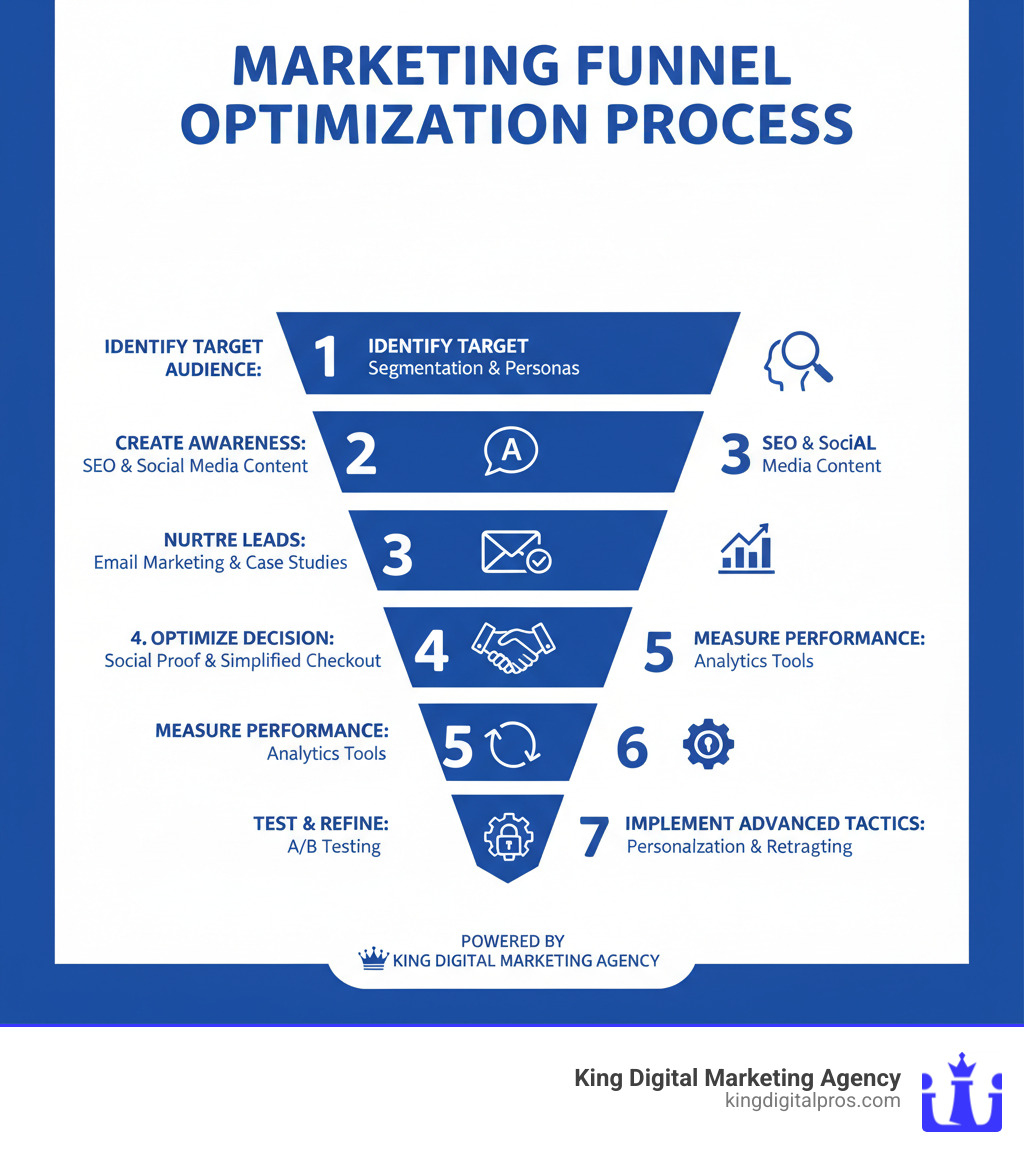
How to optimize a marketing funnel for conversions is a critical question for any business owner watching website traffic grow while sales remain flat. The solution involves a systematic approach:
- Identify and segment your audience based on behavior and needs.
- Create stage-specific content to guide prospects from awareness to decision.
- Optimize landing pages and CTAs to reduce friction.
- Use social proof to build trust at key decision points.
- Implement retargeting to re-engage visitors who didn’t convert.
- Test continuously with A/B testing on headlines, buttons, and layouts.
- Measure key metrics like conversion rate and cost per acquisition.
- Simplify your sales process by removing unnecessary steps.
If you’re wondering why 97% of visitors leave without buying, you’re not alone. The average website conversion rate is only about 3%, meaning most businesses are losing potential revenue daily. The problem isn’t traffic; it’s what happens after a visitor lands on your site.
Think of your marketing funnel like a kitchen funnel. If it has cracks or clogs, you’ll lose what you’re trying to capture. Similarly, prospects drop out of your marketing funnel due to fixable issues like confusing navigation, weak calls to action, or a complicated checkout process.
The good news is that strategic optimization yields significant results. Businesses excelling at lead nurturing generate more opportunities, while A/B testing and landing page optimization can boost conversion rates dramatically.
I’m Bernadette King, founder of King Digital Marketing Agency. For over a decade, I’ve helped businesses fix these leaks. In this guide, I’ll share proven strategies to turn more visitors into customers, focusing on how to optimize a marketing funnel for conversions without needing a massive budget or a technical background.
Understanding the Marketing Conversion Funnel
Before optimizing, we must understand what a marketing funnel is: the roadmap of a customer’s journey from initial awareness to loyal advocate. Understanding this path is essential if you want to know how to optimize a marketing funnel for conversions. You can’t fix what you don’t understand. For a deeper look at our strategies, see our Conversion Optimization services.
What is a Conversion Funnel and Why Is It Important?
A conversion funnel is the step-by-step path a prospect takes to complete a desired action, like a purchase or a sign-up. It provides a clear view of the customer journey, helping to identify where people get stuck or drop off.
While often used interchangeably, marketing, sales, and conversion funnels have distinct roles. A marketing funnel builds awareness and interest. A sales funnel guides interested leads through the purchase process. A conversion funnel focuses on a specific action, from a major purchase (macro-conversion) to smaller steps like a download (micro-conversion).
Mapping the customer journey through these funnels is crucial for focusing your budget and efforts. It allows you to pinpoint weaknesses instead of guessing. According to research from Salesforce, businesses that actively optimize their sales funnel see conversion rates increase by 10-15%. Proper optimization leads to higher ROI and data-driven decisions, creating a smoother customer experience. For more on this, our guide on What Is Conversion Rate Optimisation is a great resource.
The Key Stages of the Marketing Funnel
A typical funnel has three main stages: Top of Funnel (TOFU), Middle of Funnel (MOFU), and Bottom of Funnel (BOFU). However, the journey continues post-purchase.
- Awareness (TOFU): A potential customer finds they have a problem or finds your brand, often through a Google search. The goal is to build trust and be visible. For local businesses, effective Local SEO Keyword Research is vital here.
- Consideration (MOFU): Prospects are now actively comparing solutions. Here, you nurture the relationship with in-depth content like case studies and detailed guides to show why you’re the best choice.
- Decision (BOFU): The prospect is ready to buy. Your job is to make the “yes” easy with clear offers, social proof, and a frictionless process.
- Loyalty and Advocacy: After the sale, you turn customers into repeat buyers and brand advocates. Exceptional service and follow-ups are key. Nielsen research shows 92% of consumers trust peer recommendations, making advocates your most powerful marketing asset.
These stages align with the classic AIDA Model: Awareness, Interest, Desire, and Action, guiding customers smoothly through their journey.
Marketing vs. Sales vs. Conversion Funnels: What’s the Difference?
These related funnels have distinct goals.
| Funnel Type | Primary Goal | Focus | Key Activities |
|---|---|---|---|
| Marketing Funnel | Generate leads and build brand awareness | Attracting broad audiences and moving them towards engagement | Content marketing, SEO, social media, advertising, email list building |
| Sales Funnel | Convert engaged leads into paying customers | Guiding active prospects through browsing and shopping to the final purchase | Sales calls, product demos, personalized offers, handling objections, closing deals |
| Conversion Funnel | Drive specific desired actions (macro or micro) | Optimizing the path to any specific goal, from a download to a purchase | Landing page optimization, CTA refinement, A/B testing, user experience improvements for a singular goal |
In short, the marketing funnel focuses on lead generation, the sales funnel on the sales process, and the conversion funnel on optimizing a single, specific action. Understanding how to optimize a marketing funnel for conversions requires looking beyond the numbers to understand the why behind user behavior.
How to Optimize a Marketing Funnel for Conversions: A Stage-by-Stage Guide
Learning how to optimize a marketing funnel for conversions is about making strategic, data-driven improvements at each stage. Focus on one stage at a time for the best results.
How to optimize a marketing funnel for conversions at the Awareness stage (TOFU)
At the top of the funnel, your goal is to be helpful and visible, not to sell. This is your first impression.
- Create Buyer Personas: Don’t try to attract everyone. Build detailed profiles of your ideal customers using data from analytics and interviews to guide your marketing decisions.
- Use Local SEO: For businesses in New Mexico communities like Albuquerque or Santa Fe, local SEO is crucial. Optimize your site and content to appear in local search results. Our Local SEO Keyword Research guide can help you find what local customers are searching for.
- Leverage Content Marketing: Educate your audience with blog posts, videos, and social media updates. Helpful content builds trust and positions you as an expert.
- Build a Community: Engage with your audience on social media. Four in five customers say communities are important for brand engagement. It’s about conversation, not broadcasting.
- Consider PPC Advertising: Paid ads can jumpstart awareness by targeting specific audiences in your geographic area. Learn more about our PPC Management services.
Optimizing the Middle of the Funnel (MOFU) for Consideration
At this stage, prospects are comparing options. Your job is to nurture their interest and prove you’re the best choice.

- Use Email Marketing and Automation: Send personalized, automated email sequences based on user behavior. Delivering relevant content like case studies or guides builds trust and keeps the conversation going.
- Provide In-Depth Content: Offer case studies, product demos, and detailed guides to help prospects see the value in your solution.
- Optimize Landing Pages: Create focused landing pages for specific actions. A clean, fast-loading page with a clear purpose can dramatically increase conversions. Our SEO Friendly Website Design service ensures your pages are built to convert.
- Craft Compelling CTAs: Replace vague calls to action like “Submit” with specific, benefit-driven phrases like “Get Your Free Marketing Audit.” Our Copywriting Services can help you find the right words.
How to optimize a marketing funnel for conversions at the Decision stage (BOFU)
At the bottom of the funnel, your prospect is ready to choose. Make it easy and reassuring for them to say “yes.”
- Leverage Social Proof: Display customer testimonials, reviews, and case studies. Social proof can increase conversion rates significantly because people trust peer recommendations.
- Simplify the Sales Process: Nearly 70% of shoppers abandon carts due to complicated checkout processes. Reduce friction by asking for essential information only, offering guest checkout, and providing multiple payment options.
- Use Retargeting: Stay in front of interested visitors who didn’t convert. Retargeting campaigns show targeted ads to previous visitors, reminding them of your offer and helping to Boost Conversion Rates.
- Display Trust Signals: Remove last-minute doubts with security badges, money-back guarantees, and clear contact information. For local businesses in areas like Rio Rancho or Los Alamos, highlighting local awards builds community trust.
Measurement, Testing, and Advanced Tactics
Optimizing a marketing funnel is an ongoing process of measuring, testing, and adjusting. To master how to optimize a marketing funnel for conversions, you must be data-driven and nimble. For tool recommendations, see our guide on Must-Have Marketing Tools.
Using Analytics to Measure and Improve Funnel Performance
Analytics tools are your funnel’s health monitor, showing what’s working and what isn’t. Without data, you’re flying blind.
Start by tracking key metrics: conversion rate (the percentage of visitors who complete a goal), cost per acquisition (CPA), customer lifetime value (LTV), and bounce rate. High bounce rates often indicate a mismatch between your message and the user’s expectation.
Google Analytics 4 (GA4) is essential for mapping user journeys and identifying drop-off points. Tools like Google’s Goal Flow visualize the paths visitors take, revealing where they exit unexpectedly. To understand the “why” behind the numbers, use heatmaps and session recordings from tools like Hotjar. These show you exactly how users interact with your pages, revealing points of confusion or friction. To ensure no lead is lost, our Lead Tracking Services can help you manage every prospect.
A/B Testing for Continuous Improvement
While analytics show what is happening, A/B testing (or split testing) shows what to do about it. By creating two versions of an element (e.g., a headline or button) and showing them to different audience segments, you can see which performs better. According to research from platforms like SiteSpect, companies that use A/B testing see significant conversion rate improvements.
You can test almost anything: headlines, copy, calls to action (CTAs), page layouts, and form length. The key is to test one variable at a time to know what caused the change. This systematic approach replaces guesswork with data-backed decisions. If you’re unsure where to start, our Is Your Website Converting? service can provide a clear analysis.
Leveraging Advanced Tactics: Personalization, Urgency, and AI
Once you have the basics down, you can layer in more advanced tactics for even better results.
- Personalization: Tailor content and offers based on user data like location, browsing history, or past purchases. Personalized experiences can significantly improve click-through and conversion rates. For example, a business in Santa Fe can show different content to a local user versus a visitor from out of state.
- Urgency and Scarcity: Motivate immediate action with honest, time-sensitive offers. Countdown timers or low-stock indicators tap into the fear of missing out (FOMO), encouraging users to decide now rather than later.
- AI and Chatbots: Use AI-powered chatbots to provide 24/7 customer support, answer common questions, and qualify leads. They streamline the customer journey by making help instantly accessible. For gathering continuous feedback to refine your strategy, consider our Online Feedback Solutions.
Common Funnel Optimization Pitfalls to Avoid
Knowing what not to do is as important as knowing the right strategies for how to optimize a marketing funnel for conversions. Avoiding these common, fixable mistakes can save you from costly errors.
- Misaligned Messaging: This is a major conversion killer. If your ad promises one thing and your landing page delivers another, you create confusion and erode trust. Ensure your message is consistent across every stage of the funnel.
- Ignoring Data: Making decisions based on gut feelings instead of user behavior is like driving with your eyes closed. Data shows you exactly where your funnel is leaking. Use it to fix what’s broken and improve what’s working. Properly managing customer feedback is a great way to stay grounded in data.
- Poor User Experience (UX): A slow-loading site, confusing navigation, or a complicated checkout process will drive customers away. A page that takes more than 3 seconds to load will cause visitors to bounce. Your website should be a helpful guide, not an obstacle course.
- Over-complication: More is not always better. Too many choices, excessive text, or long forms can overwhelm and paralyze prospects. Keep your pages simple and focused on a single, clear call to action.
- Lack of Testing: If you aren’t A/B testing your headlines, CTAs, and pages, you’re leaving money on the table. Testing replaces guesswork with data, allowing you to make informed decisions that improve performance. Optimization is an ongoing process of refinement, not a one-time task.
Conclusion: Build a Funnel That Converts
Learning how to optimize a marketing funnel for conversions is not a one-time project but an ongoing commitment to understanding and serving your customers better. Just as you’d fix a leaky kitchen funnel, you must continuously repair the leaks in your marketing funnel.
Every stage – from awareness and consideration to decision and loyalty – plays a vital role. The strategies we’ve covered are proven methods for turning your digital presence into a customer-winning machine. Small, strategic changes, like simplifying a form or adding a testimonial, compound over time into significant revenue growth.
The key to success is making data-driven decisions, testing continuously, and focusing on your customers’ needs. This process of learning, refining, and improving is essential for growth, whether your business is in Taos, Corrales, or Albuquerque.
Implementing these strategies can feel overwhelming. If you need help analyzing your data and applying these techniques to attract more customers, that’s what we do at King Digital Marketing Agency. We specialize in turning marketing funnels into revenue engines for local businesses.
The optimization journey never ends, which means there’s always room to grow. Start with one stage, make one improvement, and measure the results. Over time, you’ll build a powerful conversion engine that turns prospects into loyal customers.
Ready to take the next step? Get expert help with your Conversion Optimization and let’s build a funnel that truly converts.
