Clean Up Internet Reputation: Ultimate 3-Step Fix
Why Your Online Reputation Matters More Than Ever
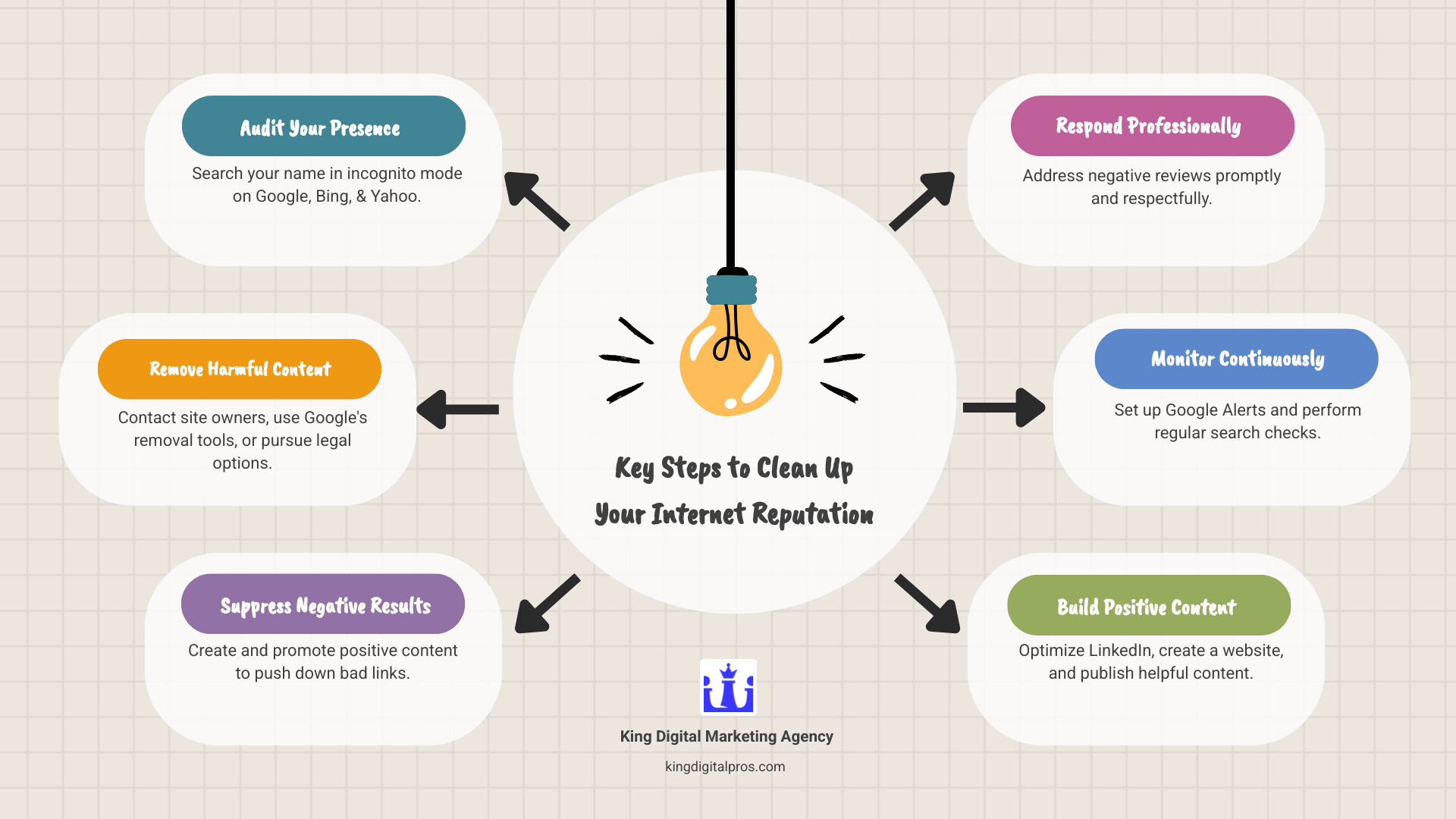
To clean up internet reputation, follow these key steps:
- Audit your presence – Search your name on Google, Bing, and Yahoo in incognito mode
- Remove harmful content – Contact site owners, use Google’s removal tools, or pursue legal options
- Suppress negative results – Create and promote positive content to push down bad links
- Respond professionally – Address negative reviews promptly and respectfully
- Monitor continuously – Set up Google Alerts and regular search checks
- Build positive content – Optimize LinkedIn, create a website, and publish helpful content
Your online reputation can make or break your business. Before a customer calls, before an employer interviews you, before anyone meets you-they Google you. And what shows up in those first ten results shapes their entire perception of who you are.
The stakes are real. Fewer than 5% of searchers go beyond page one of search results. That means if negative content ranks on page one, it’s likely the only thing people see about you. One bad review, one outdated news article, or one misleading complaint can cost you customers, job opportunities, and revenue.
The good news? You have more control than you think. While you can’t delete the internet, you can influence what people find. Through strategic content removal, suppression tactics, and proactive reputation building, you can take back your digital narrative.
This process isn’t just for crisis management. It’s about building trust and credibility in a world where your online presence is often your first impression. Companies with strong online reputations get nearly 7x more leads. A single-star improvement in ratings can boost revenue by 10%. For individuals, a clean digital footprint can mean the difference between landing your dream job and getting passed over.
The challenge is knowing where to start. Most business owners are too busy running their operations to steer the complex world of search algorithms, review platforms, and content suppression. The technical jargon and scattered advice online make it worse.
I’m Bernadette King, and I’ve helped dozens of local businesses and professionals clean up internet reputation issues and build stronger digital presences through strategic content marketing and SEO. Throughout my career, from in-house copywriting to founding King Digital, I’ve seen how the right approach transforms online visibility into real-world growth.
Know your clean up internet reputation terms:
Step 1: Audit and Monitor Your Online Presence
The first step to taking control of your online story is understanding what’s already out there. Think of it like a digital spring cleaning – you can’t tidy up until you know what needs to be organized, removed, or polished. This initial audit helps us identify any negative information that might be impacting your reputation and gives us a baseline to measure our progress.
Self-Auditing Your Digital Footprint
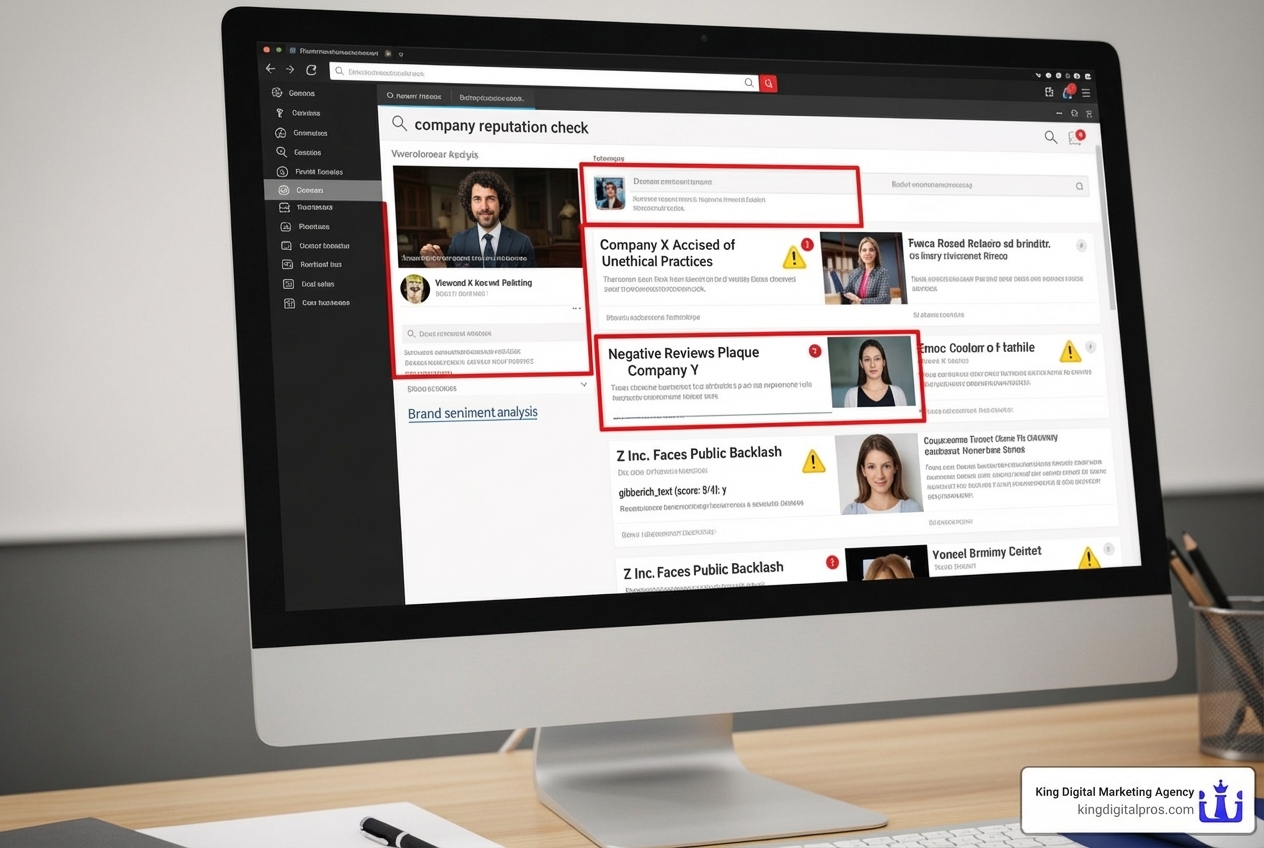
To begin, we recommend a thorough self-audit of your digital footprint. This means putting on your detective hat and searching for your name or business name just like anyone else would.
- Go Incognito: Open an incognito or private browsing window. This prevents your past search history and cookies from influencing the results, giving you a more objective view of what others see.
- Search Broadly: Start with major search engines: Google, Bing, and Yahoo. Search for your full name (and any common variations), your business name, and even relevant keywords associated with your profession or industry (e.g., “Dr. [Your Name] Albuquerque,” or “[Your Business Name] Rio Rancho reviews”).
- Dig Deep: Don’t stop at the first page! Fewer than 5% of searchers go beyond page one, but it’s crucial for us to identify everything. Document all results on pages one and two, noting anything negative, misleading, or simply outdated. This could include old social media posts, negative reviews, news articles, forum discussions, or even mugshots.
- Screenshot and Document: Take screenshots of any concerning results and keep a detailed log. Note the URL, the content, and why it’s problematic. This documentation will be invaluable as we move forward.
Setting Up a Monitoring System
Once you’ve completed your initial audit, the next crucial step is to set up a system for ongoing monitoring. Your online presence isn’t static; new information can appear at any time. Rapid response is key to preventing small issues from escalating.
The easiest way to stay informed is by setting up Google Alerts. These free alerts notify you whenever your name or business name appears in new search engine listings. This proactive approach allows us to address new mentions quickly, whether positive or negative. Set up Google Alerts to track your name and stay ahead of the curve.
For businesses, especially those in our local New Mexico communities like Santa Fe, Los Alamos, or Taos, social listening and brand monitoring tools can provide deeper insights. These tools track mentions across social media platforms, news sites, and forums, giving us a comprehensive view of public sentiment. This real-time awareness is vital for effective More info about Review Management Services.
Understanding Your Google Business Profile
For local businesses, your Google Business Profile (GBP) is often the first interaction potential customers have with you. It’s a powerhouse for local visibility and directly impacts your online reputation.
We’ve seen countless local businesses in places like Grants, Cedar Crest, and Edgewood leverage their GBP to attract more customers. It’s where people check your hours, find your address, and most importantly, read your reviews. Actively checking and responding to these reviews is paramount.
Claiming and optimizing your GBP is a non-negotiable step. If you haven’t already, we encourage you to claim and verify your profile. Our Google Business Listing Help guide can walk you through the process. Once claimed, ensure that your Name, Address, and Phone number (NAP) are consistent across all online listings. Inconsistencies can confuse search engines and customers, harming your local search rankings.
Key Strategies to Clean Up Internet Reputation
Now that we understand what’s out there and how to monitor it, let’s dive into the core strategies for how to clean up internet reputation: content removal and suppression. These two approaches work hand-in-hand to reshape your digital narrative.
Content removal is about getting problematic information taken down from its original source. Suppression, on the other hand, is about pushing negative content down in search results by promoting an abundance of positive, relevant information. Why does suppression work so well? Because, as we’ve noted, fewer than 5% of searchers go beyond page one. If we can fill the first page with positive results, those negative links effectively become invisible.

Removing Negative Content at the Source
Removing content at the source is often the most impactful solution, as it permanently deletes the information. This isn’t always easy, but it’s worth pursuing.
- Contacting Webmasters: The first step is usually to contact the website owner, editor, or webmaster directly. Look for contact information on the site’s “About Us,” “Contact,” or “Privacy Policy” pages. When you reach out, be polite, clearly explain why the content is harmful or inaccurate, and provide any supporting documentation (e.g., court orders, proof of identity). Tools like Hunter.io or WHOIS lookup can sometimes help find contact details if they’re not readily available.
- Copyright Infringement (DMCA): If someone has used your copyrighted material (e.g., photos, text) without permission, you can issue a Digital Millennium Copyright Act (DMCA) takedown notice. This is a powerful legal tool that forces websites and hosting providers to remove infringing content.
- Legal Options for Defamation or Privacy Violations: In cases of false and damaging statements (defamation/libel) or the unauthorized sharing of private information (privacy violations), legal action might be necessary. This can involve sending cease-and-desist letters or, in extreme cases, obtaining a court order for removal.
- Using Google’s Removal Tools: Google offers specific tools for removing certain types of sensitive personal information from its search results. This includes things like your Social Security number, bank account numbers, or inappropriate photos. They also have an Outdated Content Tool to remove search results pointing to content that has already been removed from the source website. For more complex legal requests, Google also provides a Legal Request Form. Google typically only removes content from its search index, not from the original website. To understand how to best manage your personal data and what Google can do, you can Learn how to manage your information on Google.
Some platforms, particularly “gripe sites” or complaint boards, are protected under Section 230 of the Communications Decency Act, which shields them from liability for user-generated content. This can make direct removal from these sites incredibly challenging.
Responding to Negative Reviews and Feedback
Negative reviews can feel like a punch to the gut, but they’re also an opportunity. How you respond can significantly impact your reputation. Studies show that how a business handles negative feedback is often more important than the feedback itself.
- Respond Professionally and Promptly: Always respond quickly, calmly, and professionally. Acknowledge the customer’s experience and thank them for their feedback, even if it’s negative. For example, “We’re sorry to hear about your experience. We value your feedback and would like to make things right.”
- Acknowledge the Issue: Show empathy and validate their feelings. Don’t get defensive or accusatory.
- Take Conversations Offline: Offer to resolve the issue directly. Provide a phone number or email address and invite them to discuss it further. This shows you’re committed to customer satisfaction and moves potentially damaging public exchanges into a private channel.
- The FTC’s Rule Against Fake Reviews: Be aware of the rules! The Federal Trade Commission (FTC) has made it clear: you cannot buy, sell, or trade fake reviews. This also extends to “review gating,” which means only asking happy customers for reviews. Platforms like Google and Yelp actively combat these practices and can penalize businesses that violate their guidelines. Always strive for genuine feedback from real customers. You can Read the FTC’s final rule on fake reviews and testimonials to ensure compliance.
Managing customer feedback effectively is a cornerstone of a healthy online reputation. Our Manage Customer Feedback guide offers more in-depth strategies.
Understanding the ‘Right to Be Forgotten’
The “Right to Be Forgotten” (RTBF) is a legal concept that allows individuals, under certain circumstances, to request that search engines remove links to certain information about them.
This right primarily applies in the European Union (EU) and the United Kingdom (UK) following a landmark ruling by the European Court of Justice. It allows individuals to submit requests to search engines like Google to remove links that are “inadequate, irrelevant or no longer relevant, or excessive” when people search for their name.
However, it’s crucial to understand its limitations:
- Geographical Scope: The RTBF generally does not apply in the United States. If someone Googles you in Albuquerque, New Mexico, the RTBF won’t compel Google to remove links from search results.
- Content Still Exists: Even in the EU/UK, content removed under RTBF is typically only delisted from search engine results for searches on the individual’s name. The original content still exists on the website.
- Public Interest vs. Privacy: Search engines balance an individual’s right to privacy against the public’s right to information. Not all requests are granted.
If you are in a region where the RTBF applies, you can submit a request to Google through their specific forms. This is a complex area, and understanding the nuances is key.
Step 2: Build and Promote a Positive Online Narrative
While removing negative content is crucial, it’s only half the battle. The other, equally important, half is proactively building and promoting a positive online narrative. This is where we control your story, ensuring that when people search for you, they find a wealth of information that truly represents who you are and what you offer.
DIY steps to clean up internet reputation
You have significant power to shape your online story. Here are some actionable DIY steps:
- Optimize Your Personal Website or Blog: If you have a personal website or blog, make sure it’s up-to-date, professional, and showcases your expertise. Use relevant keywords, high-quality content, and clear calls to action. This is your digital home base.
- Create a Professional LinkedIn Profile: LinkedIn is a powerful platform for professionals. Ensure your profile is complete, highlights your skills and experience, and includes recommendations. Actively engage with your network and share industry insights.
- Secure Other Social Media Profiles: Review your privacy settings on platforms like Facebook, Twitter (X), and Instagram. Adjust them to limit public visibility of personal posts. Consider archiving old content that no longer reflects your current image. For businesses, ensure your social media profiles are consistent with your brand messaging. We can help you craft compelling messages with our Services: Copywriting.
Here’s a list of positive content you should actively create and promote:
- Professional Bios: Craft compelling bios for your website, social media, and any guest posts.
- Case Studies: Showcase your successes and the value you bring, especially for businesses.
- Positive News & Press Releases: Share achievements, community involvement, and new developments.
- Testimonials & Endorsements: Feature positive feedback from clients, colleagues, or customers.
- Thought Leadership Articles: Publish articles on industry topics to establish your expertise.
- High-Quality Images & Videos: Visual content is engaging and helps tell your story.
Optimizing Your Digital Assets for Search
Creating positive content is excellent, but it needs to be seen. This is where SEO (Search Engine Optimization) comes into play. We use SEO strategies to ensure your positive content ranks highly in search results, effectively pushing down any lingering negative links.
- SEO for Owned Properties: Optimize your website, blog, and social media profiles. Use relevant keywords, create compelling meta descriptions, and ensure your site is mobile-friendly. For our local businesses in places like Tijeras and Sandia Park, local SEO is particularly critical. Our Optimize Local Search Ultimate Guide provides comprehensive strategies for this.
- Creating and Promoting Content on Authoritative Sites: Publish guest posts on reputable industry blogs, secure interviews with local media, and create profiles on industry-specific directories. When authoritative sites link to or feature your positive content, it signals to search engines that your content is valuable and trustworthy, helping it rank higher.
By actively building and promoting a positive narrative, we’re not just reacting to negative information; we’re proactively shaping the perception of your brand or personal image online.
Step 3: Long-Term Maintenance and When to Get Help
Cleaning up your internet reputation isn’t a one-and-done task; it’s an ongoing process. The digital landscape is constantly evolving, and maintaining a healthy online presence requires continuous effort. However, recognizing when to call in the professionals is just as important as knowing what you can do yourself.
A clean online reputation can lead to tangible business benefits. For instance, some businesses have seen a 33% increase in monthly client inquiries after successfully managing their online reputation. This demonstrates the real-world impact of a well-maintained digital image.
Maintaining a Healthy Reputation
Our long-term strategy focuses on consistent monitoring, content creation, and engagement. Here’s a comparison of tasks you can handle yourself versus when it might be time to bring in expert support:
| DIY Tasks (Ongoing) | Professional Tasks (As Needed) |
|---|---|
| Set up and monitor Google Alerts | Legal takedowns for defamation or privacy violations |
| Respond to all reviews (positive & negative) | Advanced content suppression campaigns for persistent negative results |
| Regularly update your Google Business Profile | Complex removal of public records (e.g., arrest records, court documents) |
| Post positive content on your social media | Managing large-scale reputational crises |
| Optimize your website/blog with fresh content | Deep web monitoring for hidden threats |
| Monitor major review sites (Google, Yelp) | Strategic link building from high-authority sites to positive content |
Creating a robust long-term content plan is essential. This involves consistently publishing valuable content, whether it’s blog posts, social media updates, or video content. Our Local Marketing Strategy Complete Guide can help you develop a plan that keeps your online presence fresh and positive.
When to hire a professional to clean up internet reputation
While many aspects of online reputation management can be handled in-house, there are specific situations where professional help becomes invaluable:
- Complex Issues: If you’re dealing with persistent negative news articles, legal records, mugshots, or malicious attacks that you can’t remove or suppress effectively on your own, it’s time to call in the experts. These situations often require specialized legal knowledge, advanced SEO tactics, and deep understanding of platform policies.
- Lack of Time or Resources: For busy individuals and local businesses, dedicating the necessary time and effort to comprehensive reputation management can be challenging. Professionals have the tools, expertise, and dedicated time to handle the ongoing monitoring and strategy implementation.
- When DIY Efforts Are Not Enough: You’ve tried everything, but those stubborn negative links just won’t budge from the first page. This is a clear sign that a more sophisticated approach is needed.
Hiring a professional team like ours at King Digital means you benefit from years of experience in navigating the complexities of online reputation. We can provide custom strategies, use advanced tools, and accelerate the process of removing or suppressing harmful content. For local businesses in particular, expert help with Business Profile Optimization can significantly improve your visibility and credibility. We ensure your online presence is not just clean, but also a powerful asset for growth.
Frequently Asked Questions about Reputation Cleanup
We understand that cleaning up your internet reputation can raise a lot of questions. Here are some of the most common ones we encounter:
How long does it take to fix an online reputation?
The timeline for fixing an online reputation varies significantly depending on the severity of the negative content, its source, and the resources dedicated to its removal or suppression.
- Quick Wins (Days to Weeks): Simple fixes, like adjusting privacy settings on social media or removing an outdated image from a personal blog, can be resolved quickly.
- Noticeable Changes (1-3 Months): You might start seeing significant shifts in search results within one to three months, especially with consistent content creation and proactive review management.
- Significant Improvement (6-12 Months): For more complex issues involving content suppression or dealing with high-authority sites, a complete turnaround and a truly clean internet reputation often takes six to twelve months of sustained effort. Reputation management is a marathon, not a sprint.
Can I completely delete something from the internet?
Often, no. The internet has a long memory. While you can remove content from its original source (e.g., deleting a social media post, convincing a webmaster to take down an article), once something has been indexed by search engines or widely shared, it can be extremely difficult, if not impossible, to achieve a complete, permanent deletion from every corner of the web.
Our focus is on removing content from the source website first. If that’s not possible, we aim for de-indexing from search engines. This means the content may still exist somewhere online, but it won’t appear when someone searches for your name, effectively making it invisible to the average person.
What are the limitations of reputation management services?
While professional reputation management services offer significant advantages, it’s important to understand their limitations:
- No Absolute Guarantees: No service can guarantee 100% removal of all negative content, especially if it’s legally published and factual. We operate within legal and ethical boundaries.
- Legal and Platform Constraints: We are bound by the laws of free speech and the terms of service of various platforms. Content that doesn’t violate these rules is harder to remove directly.
- Costs Can Be Significant: Comprehensive reputation management, especially for severe issues, can involve substantial investment due to the specialized expertise, tools, and time required.
- Requires Ongoing Effort: Even after a major cleanup, maintaining a positive online reputation requires continuous monitoring and proactive content creation. It’s not a one-time fix.
- Potential Drawbacks: In some rare cases, aggressive attempts to remove content can draw more attention to it, a phenomenon sometimes referred to as the “Streisand effect.” A nuanced approach is always best.
Conclusion: Take Control of Your Online Story
Your online reputation is a dynamic, changing reflection of your digital presence. In today’s interconnected world, it’s not just an asset; it’s a necessity for personal and professional success. We’ve walked through the essential steps to clean up internet reputation: from auditing your current footprint and strategically removing or suppressing negative content, to proactively building a positive narrative and committing to long-term maintenance.
The power to shape your online story is within your grasp. By taking these proactive steps, you’re not just reacting to problems; you’re empowering yourself to define how the world sees you. A positive online reputation translates into real-world opportunities – more clients, better job prospects, and improved trust.
For expert help in managing your digital presence, especially for local businesses across Albuquerque, Rio Rancho, East Mountains, Corrales, Santa Fe, Los Alamos, Taos, Grants, Cedar Crest, Edgewood, Sandia Park, and Tijeras, King Digital offers specialized services. We’re here to help you steer the complexities of online reputation management and ensure your digital story is one of success. Contact us for professional Reputation Management services and let’s start building a brighter digital future together.
