Customer feedback management software: 4 Strategic Picks
Why Customer Feedback Management Software is Your Secret Weapon for Growth
Customer feedback management software is a platform that helps businesses systematically collect, analyze, and act on customer opinions from surveys, social media, and reviews. These tools centralize feedback into one dashboard, enabling teams to spot trends, prioritize improvements, and close the loop with customers, ultimately driving satisfaction and revenue.
Top customer feedback management software options include:
- Userback – Best for visual feedback with screenshots and session replays
- Canny – Best for product roadmaps and feature voting
- Qualtrics XM Platform – Best for enterprise-level experience management
- Survicate – Best for multi-channel survey distribution
- Zendesk – Best for integrating feedback with customer support
Consider this: 57 percent of consumers say they would switch to a competitor after just one negative interaction. This isn’t just about damage control; it’s about turning customer voice into a strategic asset. The right software helps you understand patterns, prioritize fixes, and prove the ROI of experience improvements. Companies that master this see reduced churn, higher retention, and better products.
This guide will help you cut through the noise and find the right tool for your business. We’ll break down the core functionalities, explore the main categories, and provide a framework for making the right choice. Whether you’re a local business owner improving your online reputation or a product team building the next big thing, this article will show you how to turn feedback into a growth engine.
I’m Bernadette King, founder of King Digital Marketing Agency. I’ve helped countless businesses transform their digital presence by leveraging customer feedback management software to improve online reputation, boost visibility, and attract more customers. Let’s dive in.
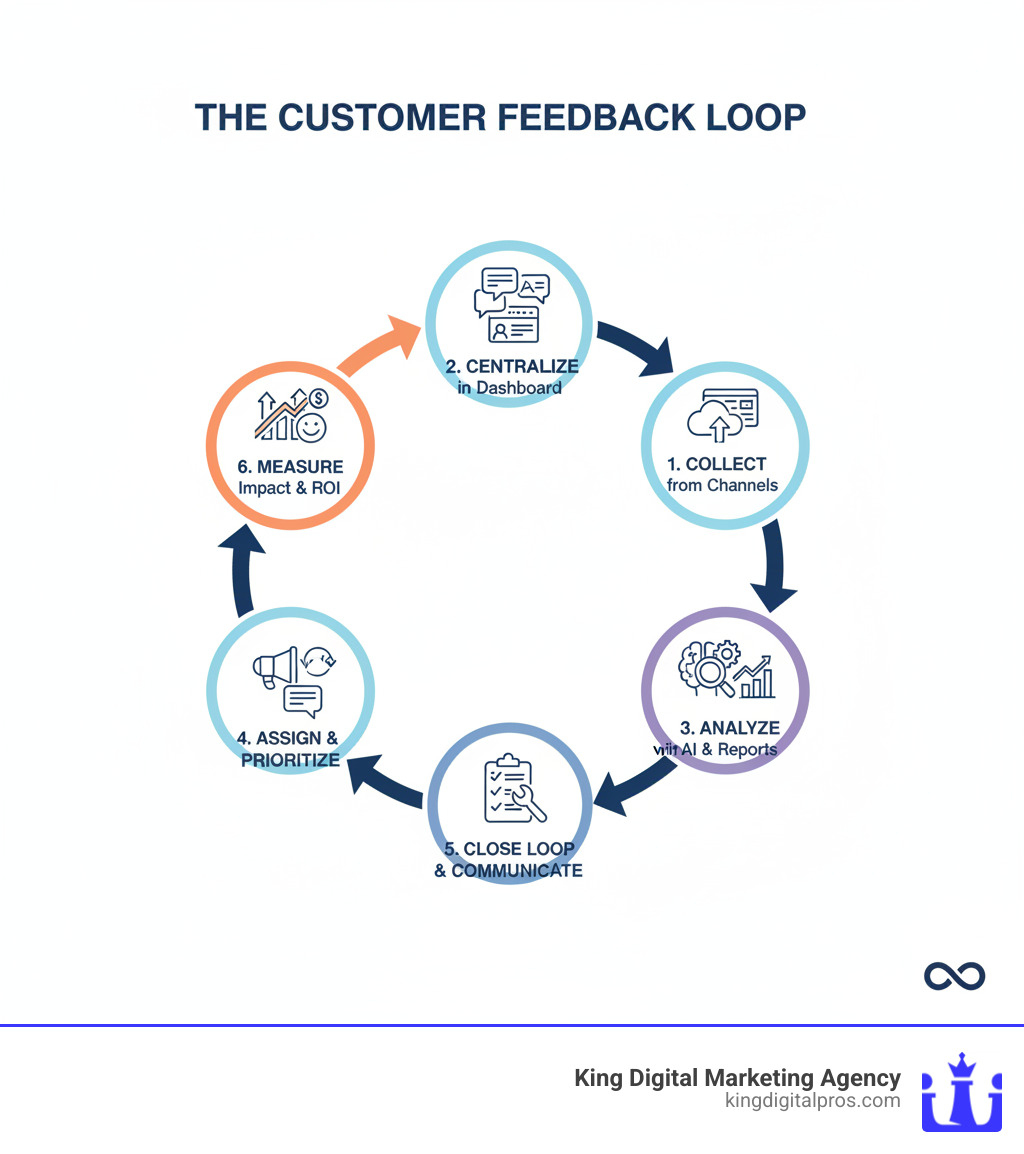
What is Customer Feedback Management Software and Why is it Crucial?
Customer feedback management software is a business’s central hub for understanding customer sentiment. It’s a platform designed to collect, organize, analyze, and act on opinions from every channel. Instead of letting insights get lost in scattered emails and spreadsheets, this software brings everything together for meaningful action.
This is more critical than ever. The Zendesk Customer Experience Trends Report 2024 found that 57 percent of consumers will switch to a competitor after just one negative interaction. The right software acts as an early warning system, helping you spot problems, understand what’s working, and turn insights into improvements. This not only prevents customer loss but also builds a reputation that helps improve your Local Business Reputation.

The Core Functionalities of Feedback Platforms
Good customer feedback management software combines several key features:
- Multi-channel Collection: Gathers feedback from surveys, in-app widgets, social media, support tickets, and online reviews.
- Centralized Dashboards: Organizes all feedback in one place for a big-picture view.
- Real-time Analytics & Sentiment Analysis: Tracks metrics and uses AI to understand if feedback is positive, negative, or neutral.
- Trend Identification: Spots patterns over time so you can be proactive.
- Task Assignment & Workflows: Automates notifications and routes feedback to the right teams to ensure action is taken.
- Integration Capabilities: Connects with your CRM, help desk, and project management tools for a seamless flow of information.
The Tangible Benefits for Your Business
Implementing the right software delivers measurable results:
- Increased Customer Satisfaction & Retention: Customers feel valued when you listen and act on their feedback, which prevents churn. Retaining a customer is five to 25 times cheaper than acquiring a new one, according to Harvard Business Review.
- Data-Driven Product Innovation: Use direct customer input to build a roadmap for features people actually want.
- Improved Brand Perception: Being responsive to feedback, especially online reviews, strengthens your reputation and helps Attract More Customers.
- Greater Operational Efficiency: Automated workflows save your team hours of manual work, allowing them to focus on solving problems.
- Competitive Advantage: Understanding your customers better and adapting faster sets you apart from the competition.
A Guide to the Best Types of Customer Feedback Management Software
The market for customer feedback management software is crowded, but the “best” tool is simply the one that solves your specific business challenges. A SaaS company fixing bugs has different needs than a local business measuring post-appointment satisfaction.
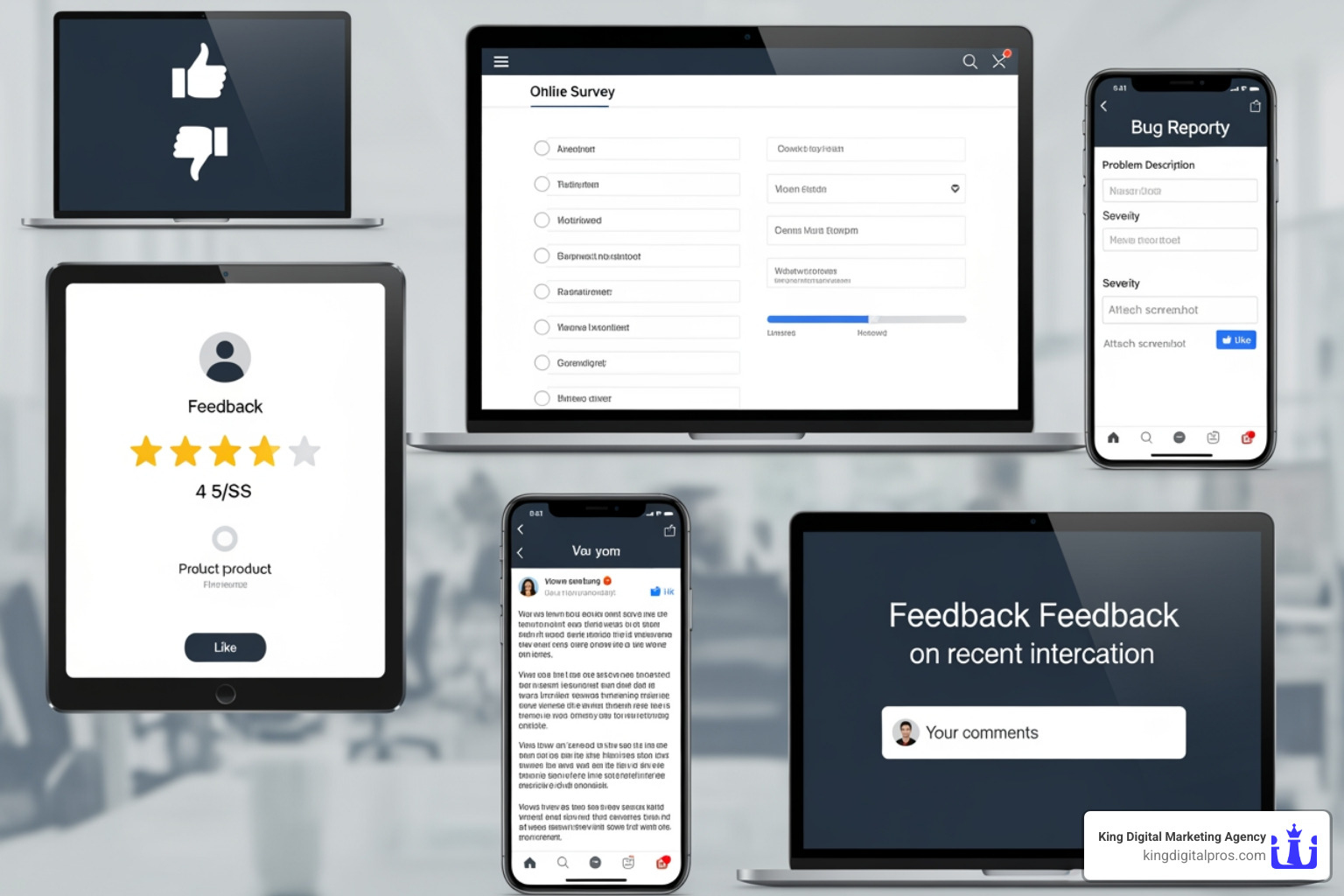
To help you find the right fit, we’ve broken down the software into four main categories based on their primary strengths:
- Visual Feedback & Bug Reporting
- Survey-Centric & CX Metric Tools
- AI-Powered Insight & Analysis Engines
- Product Roadmap & Feature Prioritization Boards
This isn’t about ranking tools; it’s about matching a category to your goals. In the following sections, we’ll explore each type to help you identify which solution is right for you.
1. Visual Feedback & Bug Reporting Platforms
Trying to describe a software bug over email is frustrating. Visual feedback and bug reporting platforms solve this by letting users show you the problem with annotated screenshots and video recordings.
These tools are essential for SaaS companies, web developers, and agencies because they eliminate guesswork. Instead of a vague description, a user can point to the exact element, add a note, and send it directly to your team. This provides clear, actionable feedback that developers can immediately understand.
Userback, the #1 user feedback software for product teams, excels here. The magic is the rich context it provides. Screenshots show the what, video recordings show the how, and technical data like console logs are captured automatically in the background. This gives your team all the information needed to diagnose issues fast.
This approach dramatically speeds up resolution. According to Userback, teams using their platform can act on feedback 10 times faster than with traditional methods. For businesses managing digital products, this category of customer feedback management software delivers immediate value by freeing up developers to fix problems rather than decipher reports. If this sounds like a fit for your workflow, you can Get Started Free to see it in action.
2. Survey-Centric & CX Metric Tools
To truly measure customer experience, you need tools built to track key metrics like NPS (Net Promoter Score), CSAT (Customer Satisfaction Score), and CES (Customer Effort Score). These survey-centric platforms are ideal for businesses that want to systematically gauge loyalty and satisfaction at key moments, such as after a purchase or a support interaction.
These tools are designed to get you answers. Consider these leading options:
- Survicate: Known for comprehensive feedback programs, it achieves an average survey response rate of 30 percent, far above the typical online survey.
- SurveySparrow: Focuses on automating feedback analysis with customizable dashboards to display results.
- Sogolytics: Delivers advanced survey design and analytics, ensuring consistent delivery across email, SMS, and social media.
- Zonka Feedback: Uses AI to provide real-time sentiment insights, automatically evaluating open-ended responses for emotion and urgency.
- Nicereply: Specializes in measuring satisfaction scores directly within your existing customer service software.
- Qualtrics XM Platform: An enterprise-level leader for Voice of the Customer (VoC) platforms, recognized in the Gartner Magic Quadrant for Voice of the Customer for its ability to identify at-risk customers.
These platforms offer advanced survey logic, multi-channel distribution, and customizable dashboards to visualize trends. For us at King Digital Marketing Agency, understanding these metrics is key to managing online reputation. Knowing how satisfied customers are allows us to address concerns before they become negative reviews. See how we apply these insights in our Review Management Services.
3. AI-Powered Insight & Analysis Engines
If you’re dealing with thousands of customer comments, support tickets, or online reviews, you know it’s impossible to analyze it all manually. AI-powered insight and analysis engines are designed for this exact challenge.
These platforms use machine learning and natural language processing (NLP) to automatically extract meaning, emotion, and actionable intelligence from high volumes of unstructured feedback.
Here’s how AI transforms customer feedback management software:
- Automated Analysis: AI performs tasks that are humanly impossible at scale. It conducts sentiment analysis to determine if feedback is positive or negative and uses topic clustering to group related comments, even if they use different wording. Tools like Zonka Feedback and Salesforce excel at this, identifying customer emotions and recurring themes automatically.
- Predictive Insights: Advanced platforms like Qualtrics can analyze customer interactions to predict satisfaction risks and identify at-risk customers before they churn, allowing businesses to intervene proactively.
- Efficiency Gains: AI automates survey generation, translation, and summarization, as seen with Salesforce. This frees up your team to focus on taking action rather than processing data.
For businesses managing an online reputation, AI-powered analysis is invaluable. It helps us at King Digital Marketing Agency quickly identify sentiment trends from reviews, which directly informs our strategies to improve our clients’ Local Business Reputation.
4. Product Roadmap & Feature Prioritization Boards
For product-led companies, deciding what to build next is a constant challenge. Product roadmap and feature prioritization boards bring order to this chaos by creating a single source of truth for customer ideas.
These specialized customer feedback management software tools help you understand which feature requests will actually move the needle. Canny, a leader in this category, helps businesses centralize suggestions, analyze them for insights, and prioritize features based on impact and effort, not just who shouts the loudest.
Key features of these platforms include:
- Public Feedback Boards: Customers can submit ideas and vote on suggestions from others, creating a community around your product and providing transparency.
- Feature Voting Systems: This quantifies demand, making prioritization decisions data-driven rather than based on guesswork. Canny has captured over 15 million feedback items this way.
- Transparent Roadmaps & Changelogs: Publicly display what you’re working on to set expectations. When a feature launches, automated changelogs notify the people who requested it, effectively closing the feedback loop.
UserVoice is another established player, helping businesses prioritize roadmaps with real customer data. By aligning development with genuine user demand, these tools help you avoid building unwanted features and create a collaborative relationship with your customers, turning them into advocates.
How to Choose the Right Customer Feedback Management Tool
Selecting the right customer feedback management software is a strategic decision. It’s not about the most features, but the best fit for your business goals.

Define Your Primary Use Case
First, ask: what problem are we solving? Your primary goal will determine the best type of tool.
- Product Development: If you’re gathering feature requests and fixing bugs, look at tools like Userback for visual reports or Canny and UserVoice for feature prioritization.
- Customer Support Improvement: To reduce tickets and improve response times, consider platforms with strong help desk integrations and sentiment analysis, like Zendesk or Salesforce.
- Marketing & UX Research: For market analysis or website usability testing, survey-centric tools like Qualtrics or visual feedback platforms are ideal.
Assess Key Features and Integrations for your customer feedback management software
Once your goal is clear, list your must-have features. Don’t choose a tool that operates in a silo. Integration with your tech stack is critical for a workflow your team will actually use.
Ensure the software connects with your essential systems:
- CRM: Linking feedback to customer profiles in Salesforce or HubSpot provides a richer understanding of each user.
- Project Management: An integration with tools like Jira or Asana is vital for turning feedback into actionable development tasks.
- Communication Apps: Connecting to Slack or similar apps facilitates internal discussion and automates critical alerts.
A seamless workflow is essential for adoption. If the tool creates extra manual work, it won’t be used effectively.
Evaluate Pricing Models and Data Security
Finally, consider the financial and security implications. Pricing models vary widely:
- Per-user: Cost is based on the number of team members.
- Per-response: Cost scales with the volume of feedback collected.
- Tiered plans: Bundles of features and usage limits at different price points.
Calculate the total cost of ownership (TCO), including setup, training, and scaling costs. A tool that’s easy to implement can have a lower TCO even with a higher subscription price.
Data security is non-negotiable. Ensure any potential vendor meets these standards:
- Compliance: The platform must be GDPR and CCPA compliant.
- Certification: Look for SOC 2 certification, which verifies the provider’s security controls.
- Encryption: Data should be encrypted both in transit (e.g., 256-bit) and at rest (e.g., AES-256). According to the National Institute of Standards and Technology (NIST), encryption is a fundamental security component.
A reputable vendor will be transparent about their security practices.
Best Practices for a Winning Feedback Strategy
Even the best customer feedback management software is useless without a strategic approach. The goal is to create a conversation with your customers, showing them their voice shapes your decisions.
Collect Feedback Across the Entire Customer Journey
Don’t wait until something goes wrong. Capture feedback at every key touchpoint to get a complete picture of the customer experience.
- During Onboarding: Was it easy to get started?
- Post-Purchase/Service: The experience is fresh, and customers are often willing to share. A BrightLocal survey notes that 96% of consumers are open to leaving a review if asked at the right time.
- After Support Interactions: A quick CSAT survey measures satisfaction with the resolution process.
- In-App/Website Usage: Feedback widgets allow users to report issues or ideas in real-time, right where they happen.
Use a mix of active methods (targeted surveys) and passive ones (always-on feedback widgets) for a comprehensive strategy. For more on this, see our guide on how to Manage Customer Feedback.
Act on Insights and Close the Feedback Loop
Collecting feedback is only half the battle. Closing the loop means demonstrating that customer input leads to real action. This is what builds trust and loyalty.
Follow these essential steps:
- Acknowledge Feedback: A simple “Thank you, we’ve received your feedback” shows respect for the customer’s time.
- Assign Ownership: Use your software to automatically route feedback to the correct team (e.g., product requests to developers, service complaints to operations).
- Prioritize Action: Use data like vote counts and sentiment scores to decide what to tackle first. This separates the critical signals from the noise.
- Communicate Resolutions: This is the most crucial step. If you build a requested feature or fix a reported bug, tell the customers who asked for it. This transparency proves you’re listening and turns customers into advocates.
Conclusion
Customer feedback management software is the difference between guessing what customers want and knowing. When 57 percent of consumers will leave after one bad experience, that knowledge is your greatest asset.
We’ve explored how different tools can transform your business, from visual bug reporting platforms to AI engines that predict churn. We’ve also found roadmap tools that turn user ideas into features that drive growth. But the best tool is one that aligns with your goals and integrates into your team’s daily workflow. A simple tool that gets used is always better than a complex one that gathers dust.
At King Digital Marketing Agency, we’ve seen businesses transform by strategically managing their online reputation and listening to customers. A key part of our work is leveraging positive feedback and systematically addressing concerns before they become public problems.
Successful businesses create a culture around feedback. They listen, act, and communicate, building trust and a reputation that attracts new customers. By managing feedback effectively, you turn customer voice into your most powerful growth engine.
Ready to transform how you listen to and act on customer feedback? Learn more about our Review Management Services and let’s build a reputation that drives real business growth.
