Funnel Analysis: Decode 3 Steps to Growth
Why Your Business Needs Funnel Analysis
Funnel analysis is a method for tracking how users move through a series of steps toward a conversion. By visualizing this customer journey, it identifies drop-off points, measures conversion rates at each stage, and provides actionable insights to fix leaks and boost revenue.
Think of your business as a storefront. Many people might look in the window, but few make a purchase. Funnel analysis tells you exactly where you’re losing people and helps you understand why.
Every touchpoint-from your Google Business Profile to your website-forms a funnel where customers can be lost. The impact of fixing these leaks is significant. For example, companies like Patreon have doubled conversions simply by analyzing and optimizing their funnels. The challenge for busy local business owners is finding the time to analyze the data that reveals where marketing dollars are being wasted.
I’m Bernadette King, founder of King Digital Marketing Agency. My team and I specialize in helping local businesses use funnel analysis to plug these leaks. We identify where potential customers drop off-from local search to your booking process-and turn more clicks into paying customers.
What is Funnel Analysis and Why Is It Crucial for Growth?
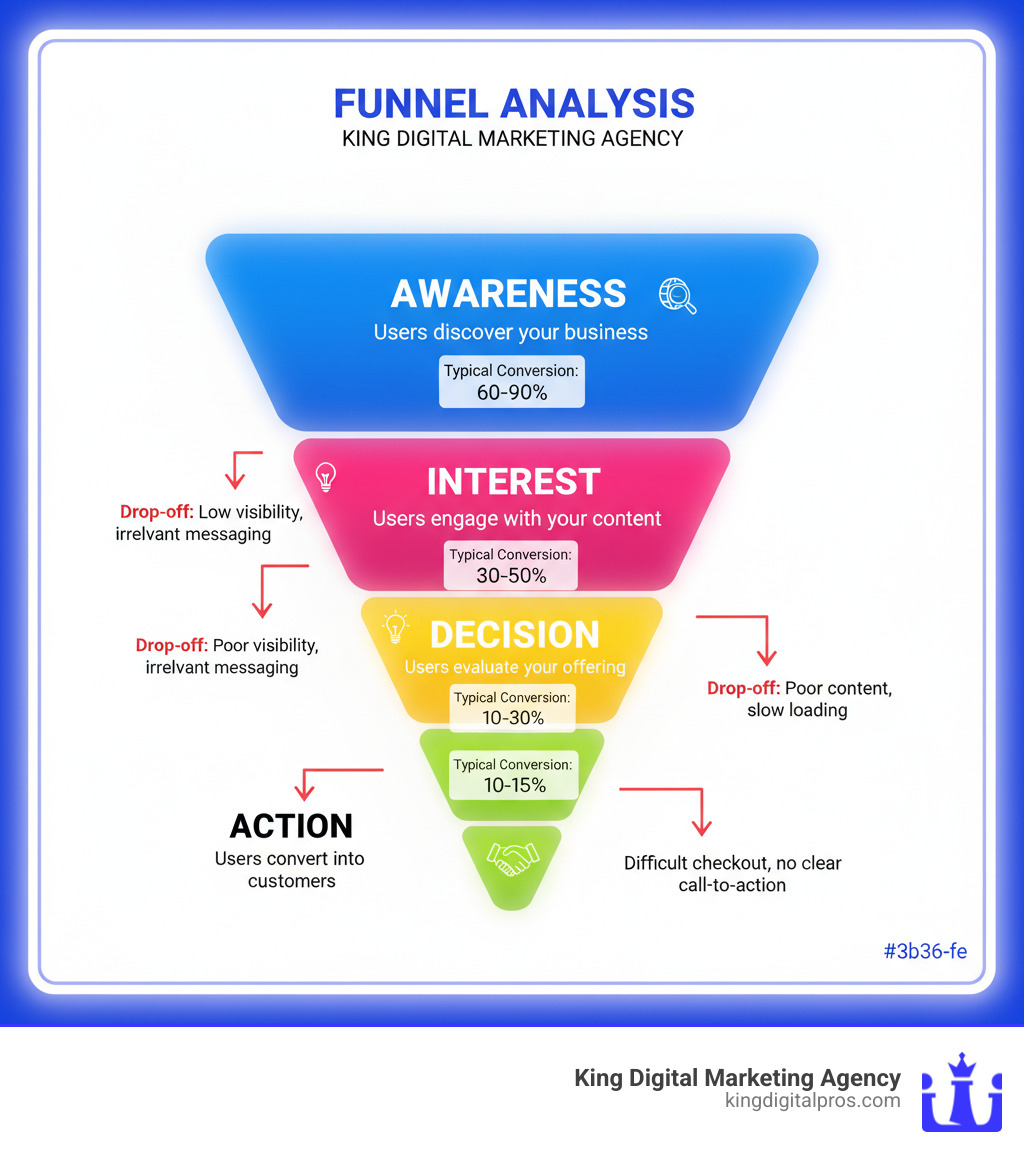
Funnel analysis maps the customer journey, showing where potential customers drop off before converting. At each stage of this “funnel,” fewer people move forward. This method replaces guesswork with data, showing you precisely where you’re losing business.
For example, if 100 people visit your service page but only 10 submit a contact form, you have clear drop-off points to investigate. Is the form too complex? Is the call-to-action unclear? Without tracking, you’re flying blind. The business impact is real: a small improvement in your conversion rate can lead to significant revenue growth. As research from McKinsey & Company on Marketing & Sales Big Data highlights, analytics are fundamentally changing how businesses drive growth.
Key Components and Business Impact
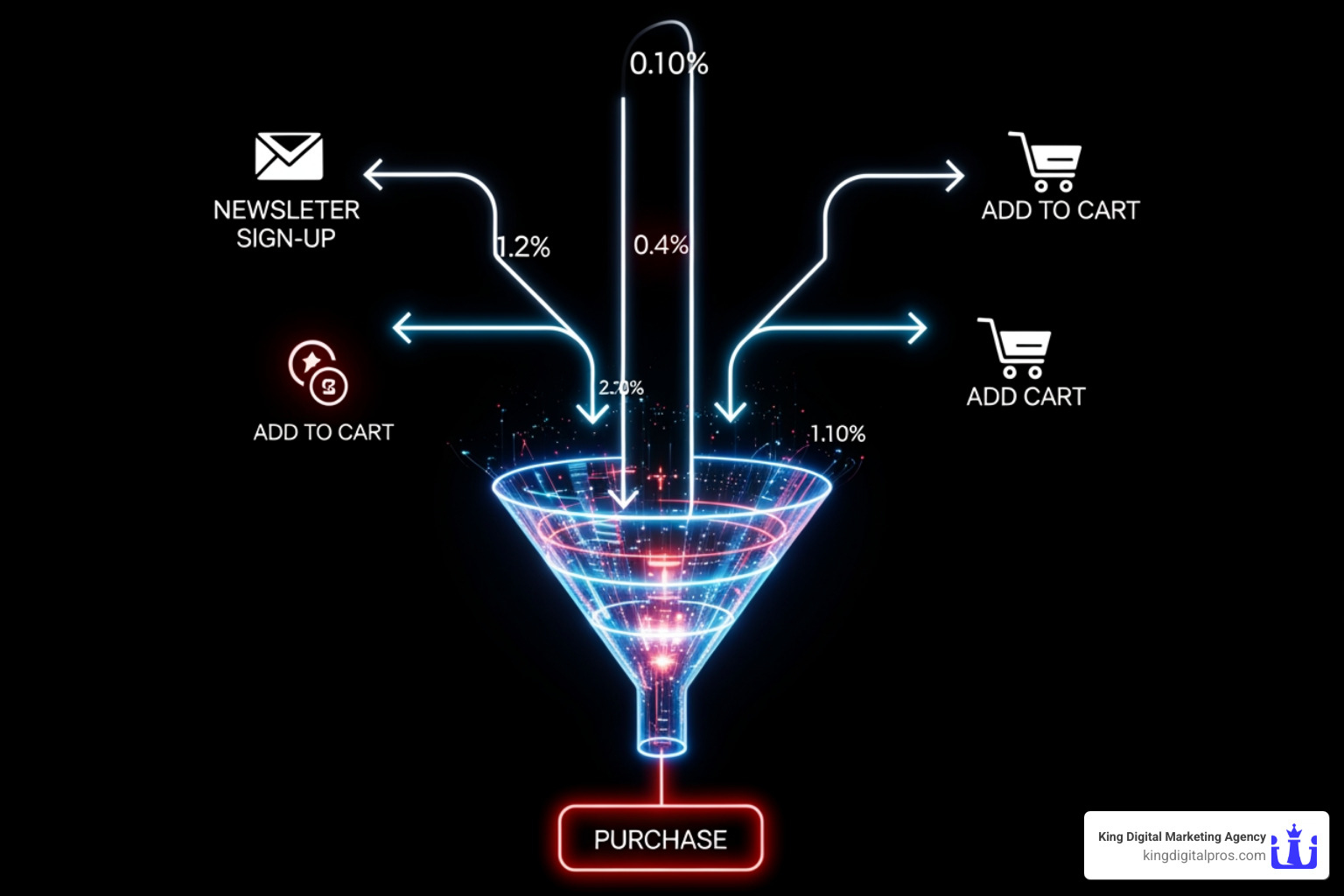
To conduct a funnel analysis, you must understand its core components. Funnel stages are the specific actions a user takes (e.g., view product, add to cart, checkout). At each stage, you track KPIs like user count and time on page, which are measured as conversion rates-the percentage of users moving to the next step. The most critical insight comes from identifying drop-off points, where users abandon the process. It’s also useful to distinguish between your main goal, a macro-conversion (like a sale), and smaller steps along the way, or micro-conversions (like a newsletter signup).
Applying these insights has a direct impact on your bottom line. It enables data-driven decisions instead of relying on hunches. By fixing leaks, you maximize your marketing ROI; the same ad spend can generate more customers. This, in turn, reduces your customer acquisition cost, as you need less traffic to hit your revenue goals. Funnel analysis provides a competitive edge by creating a smoother user experience that converts visitors into customers. To learn more about improving these numbers, see our guide on Digital Marketing Conversion Rate.
The Anatomy of a Conversion Funnel
Every business has a conversion funnel, which typically includes these stages:
- Awareness: A person first finds your business, perhaps through a Google search or a social media post.
- Interest: They begin to explore, visiting your website, reading reviews, or browsing services.
- Consideration: The potential customer compares you to competitors, checking prices, testimonials, and other details.
- Conversion: They take your desired action-making a purchase, booking an appointment, or submitting a form. This is your primary goal, or macro-conversion.
- Loyalty: The one-time customer becomes a repeat client and advocate for your brand.
Common Funnel Use Cases
Funnels vary by industry. For e-commerce, the path is often product view -> add to cart -> checkout. For SaaS companies, it’s free trial signup -> feature adoption -> paid subscription. Mobile apps track downloads -> onboarding -> regular use. Lead generation funnels guide users from a resource download to a sales call.
For local businesses, the funnel often blends digital and physical interactions. It might start with a search on Google, lead to your Google Business Profile, and result in a phone call, a request for directions, or a visit to your website. Optimizing this specific journey is crucial for businesses in Albuquerque, Santa Fe, and Taos. Our guide on Attracting Customers Via Google Maps offers strategies for this.
Defining Your Funnel’s Key Stages and Goals
To analyze your funnel, you must first define it. Start by mapping your customer journey from the first touchpoint to the final conversion. Then, set your primary conversion goal (the macro-conversion). Next, identify the 3-7 essential user actions that lead to that goal. Finally, establish baseline metrics by tracking how many users complete each step. According to the Nielsen Norman Group, these baseline metrics are the foundation of any successful optimization effort.
How to Conduct an Effective Funnel Analysis
Effective funnel analysis is a systematic process of collecting data, analyzing it for insights, and continuously refining your approach. It’s detective work to find where customers get stuck.

Step 1: Track Data and Visualize the Funnel
First, you need to see what’s happening. Start by choosing the right analytics tools, like Google Analytics, which is a powerful and free option. Then, set up event tracking to measure key user actions, such as button clicks or form submissions. Without tracking these events, your analysis is impossible. Google’s documentation on event tracking provides detailed guidance. Once events are tracked, create funnel visualization reports to transform raw numbers into a clear picture of where users are dropping off.
Step 2: Analyze Drop-Offs and Formulate Hypotheses
Knowing where users drop off is only half the battle; you need to understand why. Segment your users by criteria like traffic source (organic vs. paid), device type (mobile vs. desktop), or behavior (new vs. returning) to uncover hidden patterns. For example, you might find mobile users abandon checkout at a higher rate, indicating a design issue.
Next, combine quantitative data with qualitative insights. Use tools like heatmaps to see where users click and scroll, and session recordings to watch actual user journeys. Seeing users struggle with a confusing form or a non-clickable element provides the “why” behind the numbers. Based on this evidence, you can form educated hypotheses about the cause of the friction (e.g., “The contact form is too long, causing abandonment”).
Step 3: Test, Optimize, and Iterate
Now it’s time to fix the leaks. Use A/B testing to compare a new version of a page against the original to see which performs better. This data-driven approach proves whether your hypothesis was correct. Common areas for quick wins include:
- Landing page optimization: Improve load times, clarify messaging, and ensure your page delivers on your ad’s promise.
- Simplifying forms: Remove unnecessary fields. Every field is a potential point of friction. Concrete CMS tripled their leads by streamlining their forms.
- Improving calls-to-action (CTAs): Make your CTAs clear, compelling, and easy to find. “Get My Free Quote” is more effective than a generic “Submit.”
After implementing changes, monitor your results to measure the impact. Funnel optimization is an iterative process of testing and refining. As noted by WordStream’s research on conversion rates, systematic optimization is what separates average performers from the top 25% in any industry. For more advanced strategies, explore our guide on Conversion Funnel Optimisation Best Practices.
Advanced Techniques and Common Challenges
Once you’ve mastered the basics, you can explore deeper insights. However, advanced analysis comes with its own set of challenges.

Funnel Analysis vs. Other Analytical Methods
Funnel analysis is ideal for optimizing a known, sequential path. However, other methods offer different perspectives. User path analysis is more exploratory, showing the actual, often unpredictable, routes users take. Cohort analysis groups users by shared characteristics (like sign-up date) to track their behavior over time, which is essential for understanding retention and lifetime value. As the Nielsen Norman Group suggests, using a combination of these methods provides the most complete picture of user behavior.
Real-World Success Stories of Funnel Analysis
The impact of funnel analysis is clear from real-world results:
- Patreon doubled pledge conversions by identifying and fixing friction points in their pledge process.
- Kommunicate boosted feature adoption by 37.5% by using funnel insights to create guided product walkthroughs.
- Concrete CMS tripled its leads by applying form analytics to simplify its lead generation process.
These companies didn’t guess; they used data to identify problems, test solutions, and measure the results.
Limitations and Challenges of Funnel Analysis
While powerful, funnel analysis has limitations. Its biggest challenge is the assumption of a linear path. As the Wikipedia article on funnel analysis notes, modern customer journeys are dynamic and non-linear. Customers jump between channels, research reviews, and return later, which a rigid funnel model can miss.
Data accuracy is another critical challenge. Your analysis is only as good as your tracking setup; errors can lead to flawed conclusions. There’s also the risk of mistaking correlation for causation. A drop-off point shows where a problem exists, but not necessarily what it is. This is why qualitative context is essential. Tools like heatmaps, session recordings, and user surveys provide the “why” behind the numbers, turning raw data into actionable insights.
Frequently Asked Questions about Funnel Analysis
What are the first steps to start with funnel analysis?
Keep it simple to start. First, define one primary conversion goal (e.g., “Schedule a Service Call”). Next, identify the 3-5 essential steps a user must take to reach that goal. Finally, use a tool like Google Analytics to set up event tracking for each step and build your first funnel report. This will show you exactly where users are dropping off.
How often should I review my funnels?
Frequency depends on your traffic and how often you make changes. A good rule of thumb is:
- Weekly or Bi-weekly: A quick check of your main funnels to spot trends and catch any sudden problems.
- Monthly: A deeper look to assess the impact of recent changes and compare metrics over time.
- Quarterly or After Major Changes: A comprehensive deep-dive, including user segmentation and qualitative data review. Always analyze your funnel after a website redesign or a new marketing campaign.
Can funnel analysis be used for local businesses?
Absolutely. For local businesses in areas like Cedar Crest, Tijeras, and Sandia Park, it’s essential. A local business funnel often starts with a Google search (e.g., “plumber near me”) and a view of your Google Business Profile. The next steps might be a click to call, get directions, or visit your website. The final conversion is often a phone call, a submitted form, or an in-person visit.
Analyzing this path helps you find friction points. Is your phone number hard to find? Is your booking form too complex? Funnel analysis reveals these issues so you can turn more local searchers into paying customers. Optimizing this journey is key to growing your local business, and it often starts with being visible on Google Maps.
Conclusion: Turn Your Insights into Action
Funnel analysis is more than a report; it’s a roadmap to understanding what your customers actually do. It reveals where revenue is slipping away and provides the data needed to make smart decisions that boost your bottom line. The success of companies that have doubled conversions or tripled leads proves that this is a predictable result of a disciplined approach.
Funnel optimization is never “done.” Customer behavior and markets shift, so what works today may not work tomorrow. Treat it as an ongoing conversation with your data.
For local businesses, from Rio Rancho to Santa Fe, the funnel often begins with a local search. If the path from that search to a phone call has too much friction, you’re losing customers before they even reach your site. This is where we focus our energy at King Digital Marketing Agency-helping New Mexico businesses turn local searches into loyal customers.
Stop guessing why your traffic isn’t converting. Use funnel analysis to get answers. Pick your most important conversion path, track it, question every drop-off, and test your assumptions. Most importantly, act on what you learn.
Ready to plug the leaks in your funnel and maximize every click? Explore our expert Conversion Optimization services and let’s turn your insights into growth.
